

Have you ever raised your hands in prayer and found yourself wondering, “Am I calling upon my Creator the right way?” or “Why do some of my most heartfelt prayers feel like they haven’t been answered yet?” These are questions many Muslims ask as they seek a more profound connection with Allah (SWT).
Understanding the proper way to make dua is about more than just the words we speak; it is about the posture of the heart and following the correct dua etiquette as taught by the Prophet ﷺ.
When you learn how to make dua properly, you align your soul with the prophetic tradition, ensuring that your supplications are made with sincerity, humility, and hope.
In this complete guide, you will learn how to make dua properly in Islam, step by step, with authentic guidance from the Quran and Sunnah.
What Is the Proper Way to Make Dua in Islam?
The proper way to make dua in Islam is to begin by praising Allah, sending blessings upon the Prophet ﷺ, asking sincerely with humility, and ending with gratitude. Following the correct etiquette of dua increases the chances of acceptance.
Quick Summary: How to Make Dua Step by Step
- Praise Allah first
- Send blessings upon the Prophet ﷺ
- Raise your hands with humility
- Ask Allah sincerely
- Repeat your dua
- End with gratitude
In This Guide, You Will Learn:
- What is dua in Islam
- Why dua is important
- How to make dua step by step
- The etiquette of dua
- Best times for dua
- Common mistakes to avoid
- Frequently asked questions
What Is Dua in Islam?
At its core, dua is the act of supplication and calling out to Allah (SWT). It is the most direct form of communication a believer has with their Creator, serving as a spiritual bridge between the servant and the Lord.
In the Islamic tradition, dua is far more than just a request for help; it is considered a profound act of worship. It demonstrates a person’s humility, dependence, and absolute trust in the power and mercy of Allah.
The Prophet Muhammad ﷺ emphasized this spiritual reality by stating: “Dua is worship.” (Tirmidhi)
This simple yet powerful explanation reminds us that every time we call upon Allah, we are not just seeking an outcome, but we are actively fulfilling our purpose by acknowledging that only He can grant our needs and ease our hardships.
Why Is Dua So Important?
The importance of dua in Islam cannot be overstated. It is not merely a ritual, but a spiritual lifeline that sustains a believer through the trials and joys of life. Here are the primary reasons why dua is essential:
- Strengthens Your Relationship with Allah: Every time you make dua, you acknowledge Allah’s presence and His role as the Sustainer, fostering a deeper, more personal bond with your Creator.
- Brings Peace and Tranquility: Turning to Allah in times of distress provides immediate comfort to the heart and mind, knowing that your burdens are shared with the Almighty.
- A Means to Change Destiny (Qadr): According to the Sunnah, nothing can change the Divine Decree except dua. This gives the believer hope that their sincere prayers can alter the course of their lives for the better.
Allah (SWT) emphasizes this promise in the Quran, saying: “Call upon Me; I will respond to you.” (Surah Ghafir, 40:60)
This verse serves as a powerful reminder that the door to Allah’s mercy is always open, and the invitation to speak to Him is a gift that every Muslim should cherish
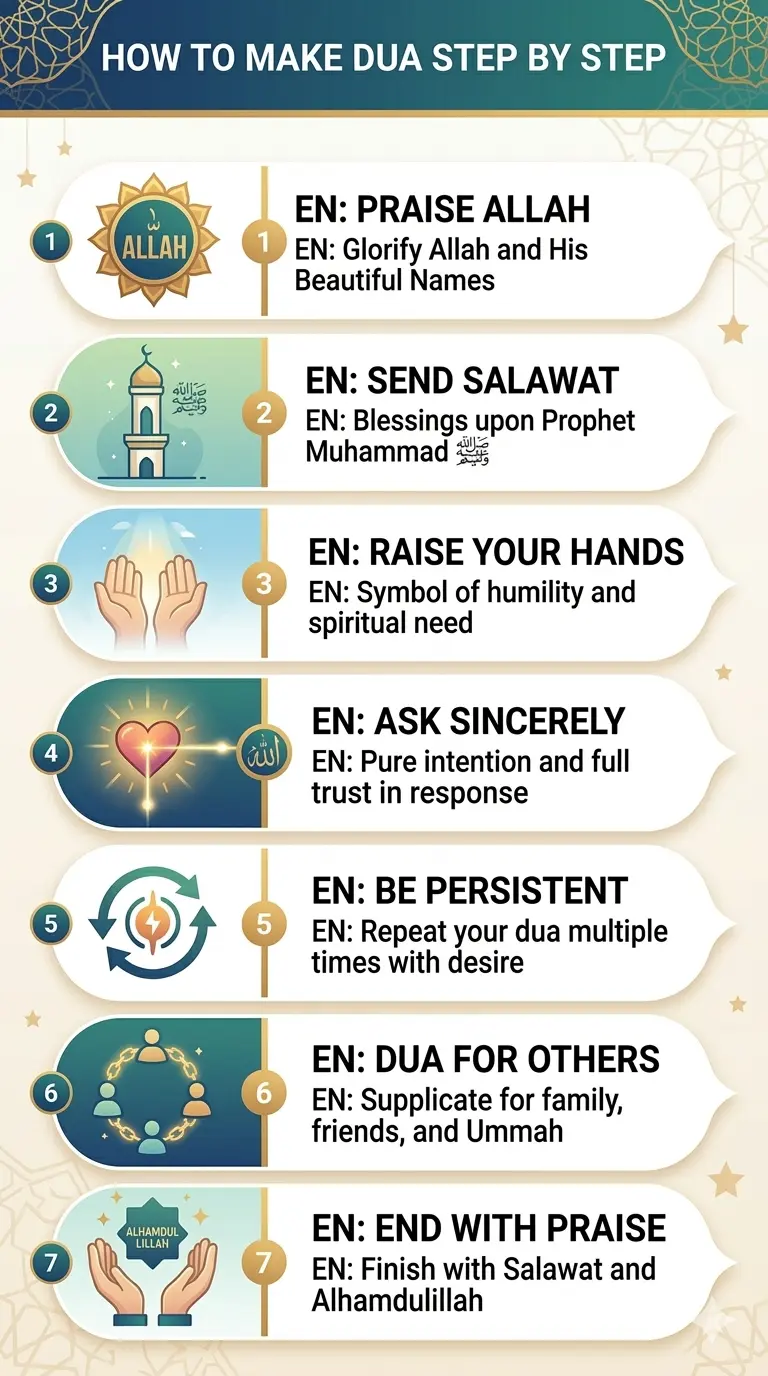
How to Make Dua Properly Step by Step
To ensure your supplication follows the prophetic tradition, follow these essential steps to refine your connection with Allah.
Step 1: Praise Allah (Al-Hamd)
The best way to begin your dua is by praising Allah and glorifying His beautiful names. Start by acknowledging His greatness and mercy.
Evidence: The Prophet ﷺ heard a man praying without praising Allah or sending blessings upon the Prophet, and he said: “This man has been hasty.”
Example: “Alhamdulillah (All praise is due to Allah), Subhanaka Allahumma (Glory be to You, O Allah)…”
Step 2: Send Blessings Upon the Prophet ﷺ
After praising Allah, send blessings (Salawat) upon Prophet Muhammad ﷺ. Scholars mention that a dua is suspended between the heavens and the earth until the Salawat is recited.
Step 3: Raise Your Hands With Humility
It is a Sunnah to raise your hands to the level of your chest or shoulders, with your palms facing upwards, as a sign of your poverty and need before Allah.
Yes, it is permissible to make dua without raising your hands. However, raising them is a Sunnah that helps increase focus (Khushoo) and humility.
Step 4: Ask Allah Sincerely (Ikhlas)
The core of your dua should be Ikhlas (sincerity). You must have Hudhur al-Qalb (presence of the heart) and Yaqeen (absolute certainty) that Allah hears you and has the power to answer.
Step 5: Ask Clearly for What You Need
Be specific in your requests. Allah loves to hear the details of your needs, whether they are for this life or the hereafter.
Examples:
- For Forgiveness: “Rabbana ighfir lana wa li’ikhwanina…” (Our Lord, forgive us and our brothers).
- For Provision (Rizq): “Allahumma ikfini bihalalika ‘an haramika…” (O Allah, suffice me with what is lawful instead of what is forbidden).
Step 6: Repeat Your Dua
Persistence is key. It is from the Sunnah to repeat your dua three times, showing your earnestness and desire for Allah’s response.
Step 7: End With Gratitude
Conclude your dua by once again praising Allah (Alhamdulillah) and sending blessings upon the Prophet ﷺ. This “seals” your supplication with the same respect with which it began.
Dua Etiquette in Islam
To truly honor the act of supplication, one should strive to embody the inner and outer manners taught by the Prophet ﷺ. Adhering to the proper etiquette of dua reflects your respect for Allah and the sincerity of your request.
Below are the essential manners to keep in mind:
- Sincerity (Ikhlas): Your dua must be directed to Allah alone. Sincerity is the foundation of every worship; ensure your heart is seeking only His pleasure and help.
- Patience and Not Being Hasty: Avoid saying, “I prayed but I was not answered.” The Prophet ﷺ taught us that Allah answers our prayers as long as we do not become impatient and give up.
- Consuming Halal: One of the most critical obstacles to dua is a lifestyle sustained by forbidden (Haram) means. Ensuring your food, drink, and income are pure is vital for the acceptance of your supplications.
- Presence of the Heart: Avoid making dua with a distracted or heedless mind. Focus on the meaning of your words and truly feel your dependency on Allah during the process.
- Avoiding Sinful Requests: A believer should never make a dua that involves something sinful or the breaking of family ties. Your requests should always be for what is good and permissible.
By refining these etiquettes, you transform your dua from a simple request into a powerful spiritual state that brings you closer to Allah’s mercy.
Best Times When Dua Is Accepted
While you can call upon Allah at any moment, there are specific periods known as the best times when dua is accepted. Seeking out these moments is a sign of a believer’s dedication and understanding of dua etiquette.
According to the Sunnah, here are the most blessed times to make your requests:
- The Last Third of the Night: This is the most powerful time for supplication. Allah descends to the lowest heaven and asks who is seeking His forgiveness and help so He may grant it.
- Between the Adhan and the Iqamah: The Prophet ﷺ taught us that a dua made between the call to prayer and the start of the prayer is never rejected.
- While in Prostration (Sujud): You are closest to your Lord when you are in Sujud. Use this posture to increase your personal supplications.
- On Fridays (Jumu’ah): There is a specific hour on Friday—often cited as the hour before Maghrib—where no Muslim asks Allah for something good except that He gives it to them.
- At the Time of Breaking the Fast (Iftar): The prayer of a fasting person at the moment of Iftar is highly valued and holds a special place for acceptance.

By being mindful of these accepted times for dua, you maximize your spiritual efforts and demonstrate your eagerness to receive Allah’s mercy and bounty.
Common Mistakes When Making Dua
Even with the best intentions, it is easy to fall into certain habits that can hinder the effectiveness of our supplications. Awareness of these common mistakes when making dua is essential for anyone seeking to refine their worship and improve their connection with Allah.
Mistake #1: Praying Without Certainty (Yaqeen)
One of the most significant dua mistakes is asking Allah while having doubt in your heart about the outcome. You must pray with the absolute conviction that Allah is Al-Mujeeb (The Responder) and that nothing is impossible for Him.
Mistake #2: Being Impatient
Many people expect immediate results and become discouraged when their request isn’t granted right away. Remember that the Prophet ﷺ warned against saying, “I supplicated but it was not answered.” Patience and trust in Allah’s perfect timing are vital.
Mistake #3: Making Dua Without Focus
Making dua with a distracted heart or a wandering mind is a common pitfall. Sincerity requires Hudhur al-Qalb (presence of the heart). Your tongue and your heart must be aligned in your plea to the Creator.
Mistake #4: Giving Up Too Early
Persistence is a beloved quality in Islam. Some believers stop making dua after a few days or weeks, but the Sunnah encourages us to be persistent (Ilhah). Do not stop knocking on the door of Allah’s mercy; He loves to hear the voice of His servant.
Common Questions About Making Dua
Can You Make Dua in Your Own Language?
Yes, you can absolutely make dua in your own language. Allah (SWT) is the Creator of all languages and knows what is in every heart. While the formal prayers (Salah) are performed in Arabic, your personal dua in your own language is valid and encouraged. Sincerity (Ikhlas) and the intent of the heart are far more important than the language used.
Can Dua Change Destiny (Qadr)?
Yes, dua has the power to change destiny. The Prophet Muhammad ﷺ said: “Nothing averts the Divine Decree except supplication.” (Tirmidhi). This means that Allah may have decreed a certain trial for a person, but because of their sincere and persistent dua, Allah removes that trial or replaces it with something better.
Do You Have to Raise Your Hands?
Raising your hands while making dua is Mustahabb (recommended) and is part of the Sunnah, but it is not Wajib (obligatory). You can make dua while walking, driving, or lying down without raising your hands. However, raising them is a sign of humility that helps in achieving better focus.
Frequently Asked Questions About Dua
Is there a specific way to make dua?
While there is no single “formula,” the most proper way to make dua is to follow the Prophetic protocol: Start by praising Allah, send blessings upon the Prophet ﷺ, ask for your needs with full certainty, and end with “Alhamdulillah.”
How long should a dua be?
There is no set time limit for a dua. It can be as short as a single sentence or as long as you need it to be. Allah loves to hear the voice of His servant, so take as much time as you need to express your heart’s desires.
Can you repeat the same dua every day?
Yes, and it is actually highly recommended. Allah loves persistence (Ilhah) in supplication. Repeating the same dua shows your deep need and trust in Allah’s power to grant your request, no matter how long it takes.
Conclusion
Dua is a profound gift and an open door to Divine mercy that never closes, regardless of the time or place. It is the most intimate conversation you can have with your Creator, serving as a reminder that you are never truly alone in your struggles or your joys.
By following the proper way to make dua and refining your dua etiquette, you transform a simple ritual into a powerful spiritual experience. The key is consistency, patience, and absolute trust in Allah’s wisdom and timing.
We encourage you not to let this knowledge remain as just information. The beauty of supplication lies in its practice. Whether your needs are small or large, turn to Al-Mujeeb with a present heart and a sincere soul.
Start applying these steps today and strengthen your connection with Allah through sincere dua.