
Zayd ibn Arqam Surah Ad-Duha represents one of the most profound intersections between historical biography and divine revelation in Islamic tradition. Have you ever navigated a season of intense spiritual silence where your prayers felt like echoes in an empty room? This agonizing interval, where the heart feels barren and the heavens seem quiet, is a trial that even the Prophet Muhammad ﷺ endured. To find true spiritual comfort during such times, we must look beyond the surface and explore the “Spiritual Nexus” where the life of a “Truthful Companion” meets the light of the morning brightness.
Fatrah al-Wahi, or the temporary cessation of revelation, was the historical context that gave birth to Surah Ad-Duha. It was a period of psychological and communal trial, marked by mockery from enemies and internal anxiety for the Prophet ﷺ. However, to fully unlock the depth of this Surah and the prayers associated with it, we must first master the story of a man whose life mirrored these very themes of orphanhood, isolation, and divine vindication: the noble companion Zayd ibn Arqam.
The Biographical Tapestry: Zayd ibn Arqam, The Truthful Companion
Zayd ibn Arqam was far more than just a passive transmitter of Hadith; he was a man who lived the virtues of patience and unyielding integrity. Emerging from the Ansar of Madinah, Zayd’s journey began with the heavy trial of orphanhood. This status creates a striking parallel with the early life of the Prophet Muhammad ﷺ, who is explicitly reminded of his own orphanhood in the opening verses of Surah Ad-Duha. Following the loss of his parents, the young Zayd was taken into the guardianship of the prominent poet-warrior Abdullah ibn Rawahah, who steeped him in the ethos of absolute dedication to the faith.
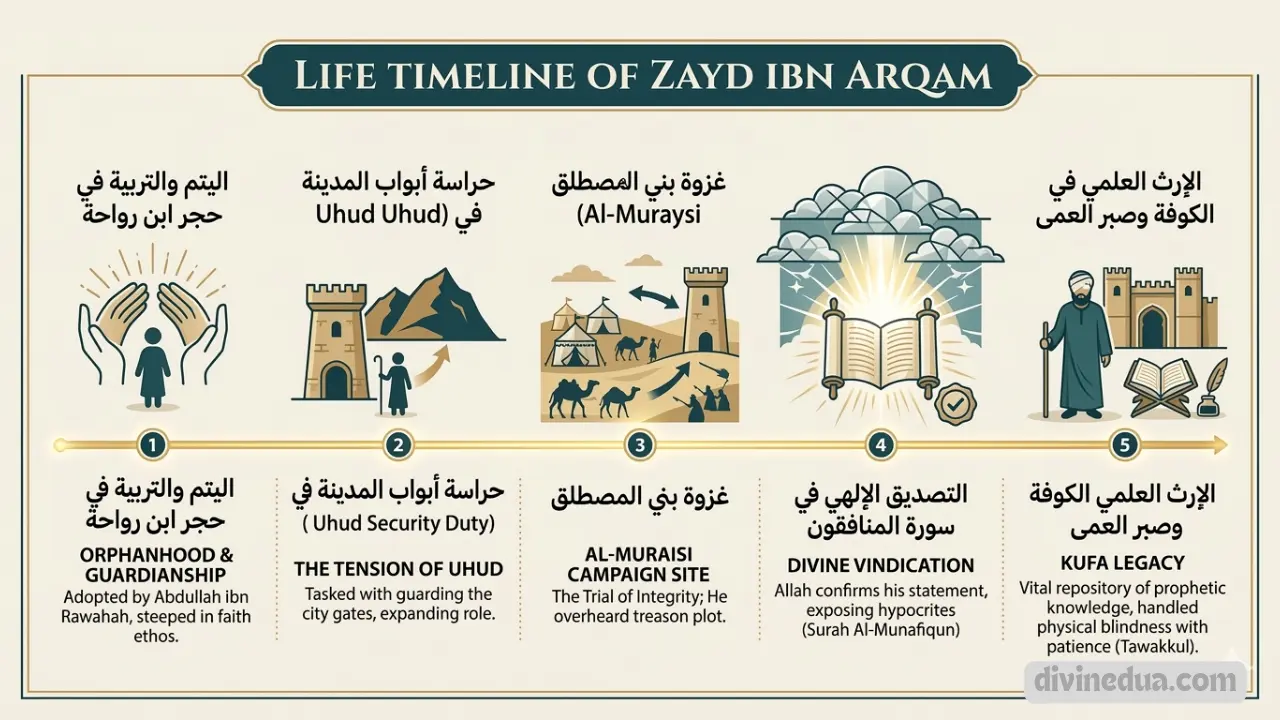
Due to his extreme youth, Zayd was deemed too young to participate in the foundational battles of Badr and Uhud. Instead of engaging in frontline combat during his early years, he was tasked with the crucial duty of guarding the city of Madinah. As he matured, his role expanded significantly, and he eventually participated in seventeen military campaigns alongside the Prophet ﷺ, including the grueling Battle of the Trench (Al-Khandaq).
The Trial of Integrity: Exposing the Hypocrites
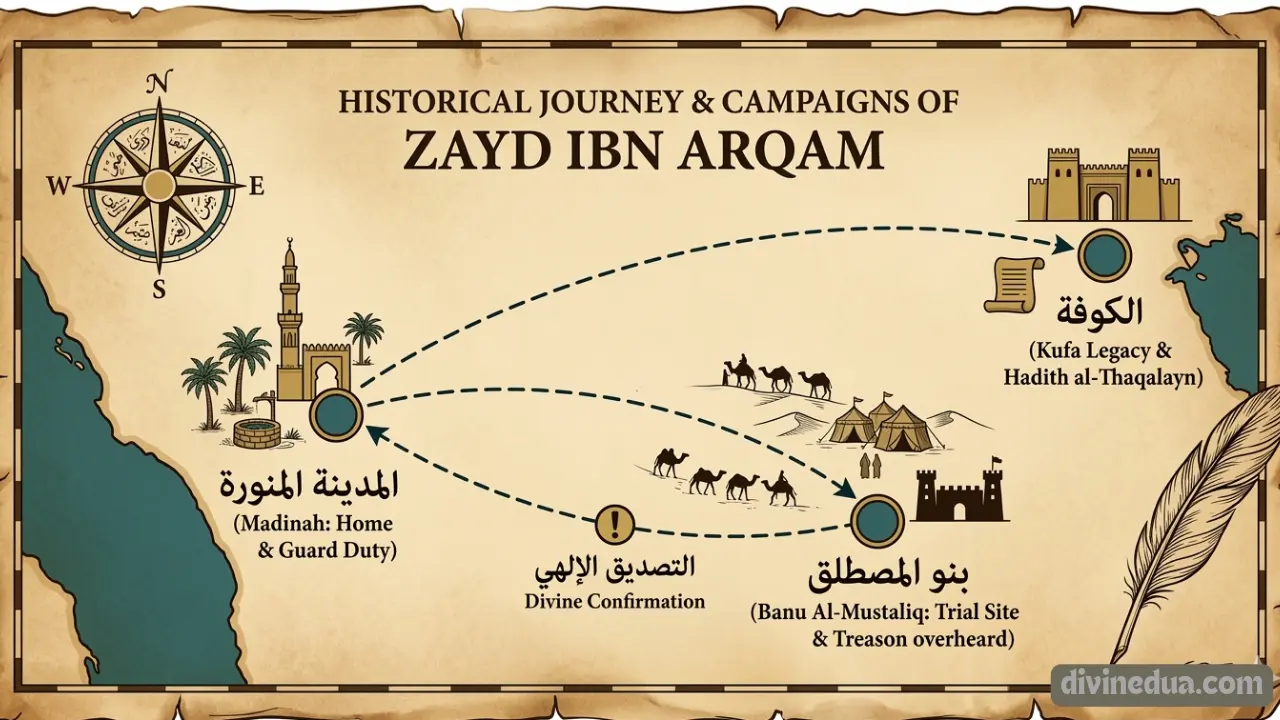
The Exposer of Hypocrites is the title Zayd earned during the expedition against Banu Al-Mustaliq (often cited by historians as the campaign of Al-Muraysi). It was during this journey that the young Zayd inadvertently overheard Abdullah ibn Ubayy, the chief of hypocrites, plotting treason. Ibn Ubayy arrogantely proclaimed that upon returning to Madinah, the “more honorable” (meaning himself) would expel the “meaner” (referring to the Prophet ﷺ). Demonstrating immense courage, Zayd reported this subversion to his uncle, who relayed it to the Prophet ﷺ.
However, when summoned to answer for their words, the hypocrites utilized their high social standing and swore emphatic, false oaths by Allah. In the face of these solemn oaths from elder figures, the Prophet ﷺ temporarily accepted their word over the testimony of the young Zayd. The psychological devastation Zayd felt was overwhelming. He retreated into agonizing isolation, staying in his home, crushed by the weight of being perceived as a fabricator. He recorded his emotional state, stating he was “distressed as I have never been before,” and even his own uncle rebuked him for causing the Prophet ﷺ to doubt him.
Surah Al-Munafiqun was the divine response that shattered this darkness. Allah revealed the verses that explicitly exposed the lies of Abdullah ibn Ubayy and confirmed Zayd’s report. The Prophet ﷺ immediately summoned Zayd, joyfully recited the new revelation, and affectionately tugged his ear, saying: “Allah has confirmed your statement.” This monumental incident solidified Zayd’s reputation as a man whose truthfulness was ratified by the heavens themselves. (Reference: Sahih Muslim 2772a)
The Trial of Blindness and the Legacy of Thaqalayn
Following the passing of the Prophet ﷺ, Zayd relocated to Kufa, serving as a vital repository of prophetic knowledge. His advanced age brought new physical trials, most notably the gradual and complete loss of his eyesight. The historical record indicates a deeply moving interaction regarding this affliction showcasing the Prophet’s ﷺ miraculous foresight. During a serious illness, the Prophet ﷺ visited Zayd and asked: “No harm shall befall you in your illness. But what would you say if you were to grow old after me and become blind?” Without hesitation, Zayd responded with immense spiritual fortitude: “I shall take Allah as my sufficient trust, and endure it patiently.” Hearing this declaration of absolute reliance, the Prophet ﷺ gave him the ultimate glad tidings: “Then you will enter Paradise without reckoning.”
Furthermore, Zayd was a central and highly trusted narrator of critical theological narrations. He is most famously known as the primary narrator of the “Hadith al-Thaqalayn” (The Tradition of the Two Weighty Things) delivered by the Prophet ﷺ at the pond of Ghadir Khumm. In this sermon, the Prophet ﷺ emphasized leaving behind two enduring guides: the Book of Allah and his Ahl al-Bayt (family). Zayd’s meticulous preservation of these traditions ensures his legacy remains permanently etched into the foundational texts of the faith. (Reference: Sahih Muslim 2408a)
Zayd ibn Arqam Blindness and the Miracle of Faith
Zayd ibn Arqam’s later life brought new physical trials, most notably the complete loss of his eyesight after relocating to Kufa to serve as a vital repository of prophetic knowledge. The historical record indicates a deeply moving interaction regarding this affliction, showcasing the Prophet’s ﷺ miraculous foresight. During a serious illness, the Prophet ﷺ visited Zayd and asked: “No harm shall befall you in your illness. But what would you say if you were to grow old after me and become blind?” Without hesitation, Zayd responded with immense spiritual fortitude: “I shall take Allah as my sufficient trust, and endure it patiently.” Hearing this declaration of Tawakkul (absolute reliance), the Prophet ﷺ gave him the ultimate glad tidings: “Then you will enter Paradise without reckoning.”
Furthermore, Zayd served as a central and highly trusted narrator of critical theological traditions. He is most famously known as the primary narrator of the “Hadith al-Thaqalayn” (The Tradition of the Two Weighty Things) delivered by the Prophet ﷺ at the pond of Ghadir Khumm. In this monumental sermon, the Prophet ﷺ emphasized leaving behind two enduring guides: the Book of Allah and his Ahl al-Bayt (family). Zayd’s meticulous preservation of such traditions ensures his legacy remains permanently etched into the foundational texts of the faith. (Reference: Sahih Muslim 2408a)
The Jurisprudential Architecture of Salat al-Duha According to Zayd
Jurisprudence of Duha is often simplified in modern discourse, but Zayd ibn Arqam provided a masterclass in its precise timing and spiritual significance. While his biography anchors our emotions, his legal contributions anchor our daily worship. He is the primary source for the most definitive Hadith establishing the optimal timing for this voluntary prayer, bridging the gap between mere ritual and a highly calibrated spiritual methodology.
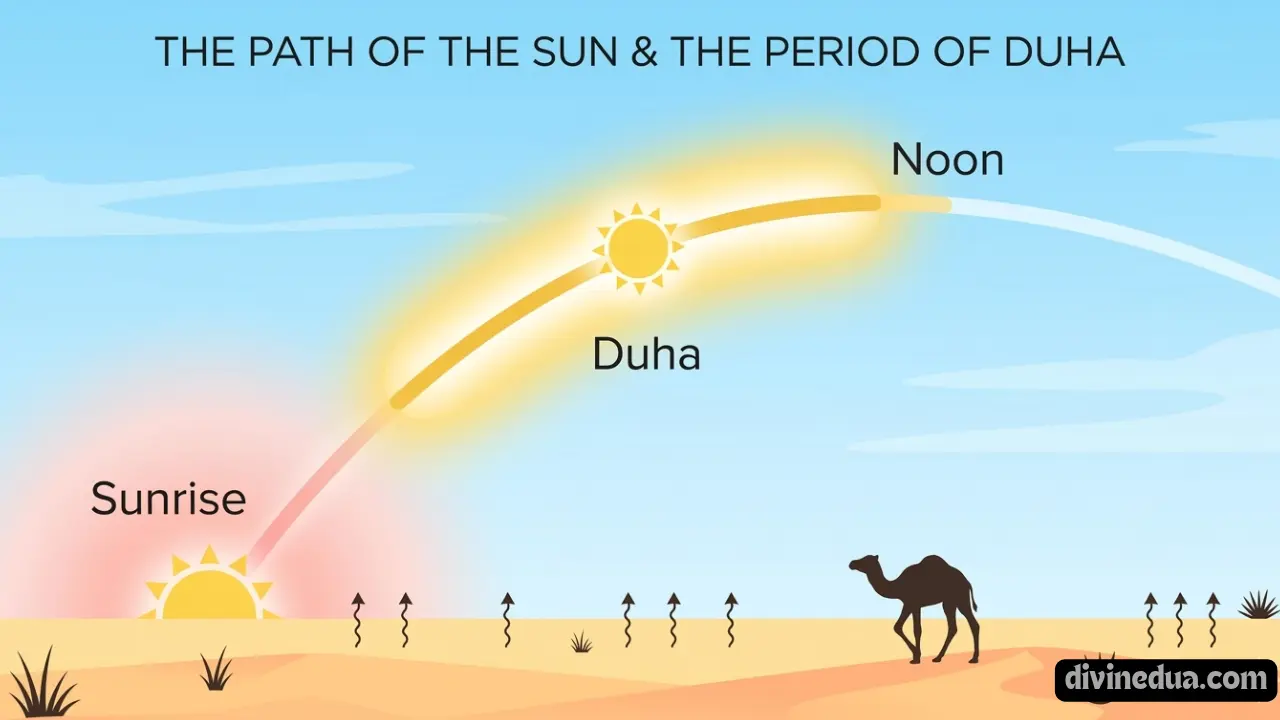
Sahih Muslim 784 serves as the foundational text for this practice. The historical context of this narration reveals Zayd ibn Arqam observing a group of people performing the forenoon prayer relatively early in the day, shortly after the sun had risen. Recognizing that while their action was permissible, a later time held significantly greater spiritual merit, he remarked: “They already know that prayer at a different time is better.” He then transmitted the explicit guidance of the Prophet ﷺ: “The forenoon prayer of the penitent is when young camels can feel the heat of the sun.” (Reference: Sahih Muslim 748/784)
Salat al-Awwabin: The Prayer of the Constantly Returning
Salat al-Awwabin is the specific term utilized by the Prophet ﷺ in Zayd’s narration. To fully grasp its magnitude, one must undertake a linguistic analysis of the word Awwabin. It is an intensive plural noun derived from the root indicating a continuous, repetitive returning. It refers specifically to those who are perpetually returning to Allah in sincere repentance and remembrance after being distracted by worldly affairs. By linking the Duha prayer to the Awwabin, the Prophet ﷺ elevated it from an optional act to a defining characteristic of the spiritually vigilant.
The spiritual and psychological wisdom behind this is profound. Mid-to-late morning is typically the period when individuals are most deeply engrossed in commerce, professional routines, and worldly noise. To intentionally pause during the absolute peak of productivity to stand in remembrance of Allah demonstrates a radical prioritization of the eternal over the temporal. It effectively bridges the long, potentially distracting interval between the Fajr (dawn) and Dhuhr (noon) prayers, ensuring the heart does not succumb to Ghaflah (heedlessness).
Tarmathu al-Fisal: The Vivid Metaphor of the Heat
Tarmathu al-Fisal is the vivid desert metaphor the Prophet ﷺ used to convey the “peak” window for this prayer. This phrasing translates literally to “when the young weaned camels feel the heat of the sun.” To understand the Salat al-Duha best time, we must look at the two components of this metaphor:
- Fisal: Refers specifically to young camels that have been recently weaned from their mothers. At this stage of development, their hooves are still soft, tender, and highly sensitive to external conditions.
- Tarmathu: Refers to the burning sensation caused by the scorching heat of the sand when the sun has risen high enough.
Therefore, the Prophet ﷺ was identifying a very specific window in the late morning—roughly halfway between sunrise and the Dhuhr prayer—when the Arabian sun has heated the earth to a point where these young, sensitive animals seek shelter. Classical scholars, including the renowned Imam al-Nawawi, utilized Zayd’s precise narration to define this as the most virtuous and highest-rewarding time for the prayer.
Regarding the physical structure, the jurisprudence dictates that Salat al-Duha consists of a minimum of two Rak’ahs. However, it can be extended up to a maximum of eight Rak’ahs, as evidenced by the Prophet’s ﷺ practice when he entered the house of Umm Hani on the day of the Conquest of Makkah and performed eight Rak’ahs in units of two.
The Structure and Practical Application
Regarding the physical structure, the jurisprudence dictates that Salat al-Duha consists of a minimum of two Rak’ahs (cycles of prayer). However, it can be extended based on the worshipper’s spiritual capacity up to a maximum of eight Rak’ahs. This maximum is evidenced by authentic narrations detailing the Prophet’s ﷺ practice when he entered the house of his cousin Umm Hani and performed eight Rak’ahs, offering them in units of two. By establishing this connection in the “heat” of the day, the believer constructs a spiritual fortress that protects their soul for the remainder of the afternoon.
Surah Ad-Duha and the Psychological Trial of Fatrah al-Wahi
While Zayd ibn Arqam masterfully instructs us on the physical and temporal performance of the Duha prayer, the Quran itself provides the profound emotional and psychological anchor for this time of day. Surah Ad-Duha Tafsir is inextricably linked to the historical and theological concept of Fatrah al-Wahi—the painful and deeply distressing period when divine revelation to the Prophet ﷺ temporarily ceased.
During the early Meccan period, after the initial, awe-inspiring bursts of revelation, the heavens suddenly went quiet. The Archangel Jibril inexplicably stopped descending. This cessation of revelation caused the Prophet ﷺ immense psychological distress and profound sorrow. His internal anxiety was severely compounded by the hostile environment of Makkah. The Quraysh, closely monitoring the situation, launched a campaign of psychological warfare. Specifically, Umm Jamil mockery became a sharp weapon, as she, the wife of Abu Lahab, publicly taunted him, declaring: “Muhammad’s Lord has forsaken him, and is displeased with him.”
The Divine Mercy in the Silence: Neurological Preservation
Theologians and Quranic exegetes note that this agonizing pause was, in reality, a manifestation of profound divine mercy. The physical, emotional, and neurological weight of receiving direct revelation was staggering; the Quran itself describes it as a “heavy word.” Had the Prophet ﷺ been continuously exposed to the intensely bright light of revelation (Wahy) without respite, his human nerves and physical constitution would simply not have been able to endure it. This interval was deliberately granted to afford him vital physical recovery and psychological tranquility.
Furthermore, the cessation served a powerful apologetic purpose. It stood as undeniable proof to the polytheists that the Quran was not a product of the Prophet’s ﷺ own imagination. If he were fabricating the verses, he could have easily produced them to silence his critics. The fact that he remained silent until the revelation returned proved he was entirely dependent on a higher, external source.
The Exegesis of Reassurance: A Mastery of Divine Logic
When the divine silence was finally broken, it was shattered by the magnificent, soaring oaths of Surah Ad-Duha. This chapter serves as divine reassurance, providing ultimate comfort through a masterful psychological progression:
- The Present (Verses 1-3): Allah swears by the Duha (morning sunlight) and the night when it grows still (Saja). Just as the darkness and stillness of the night are natural, restful phases of the cosmos, the silence of revelation was a natural phase, not a sign of divine abandonment. “Your Lord has not forsaken you, nor has He become displeased.”
- The Future (Verses 4-5): The focus shifts from temporary pain to eternal victory. The promise that “the next life is certainly far better for you than this one” and that “your Lord will give so much to you that you will be pleased” acts as the ultimate antidote to sorrow and the “Fatrah” of the soul.
- The Past (Verses 6-8): To solidify trust, the Quran directs the Prophet ﷺ to reflect empirically on his own history through Historical Reframing. He was an orphan, and Allah sheltered him. He was searching for truth, and Allah guided him. He was poor, and Allah enriched him.
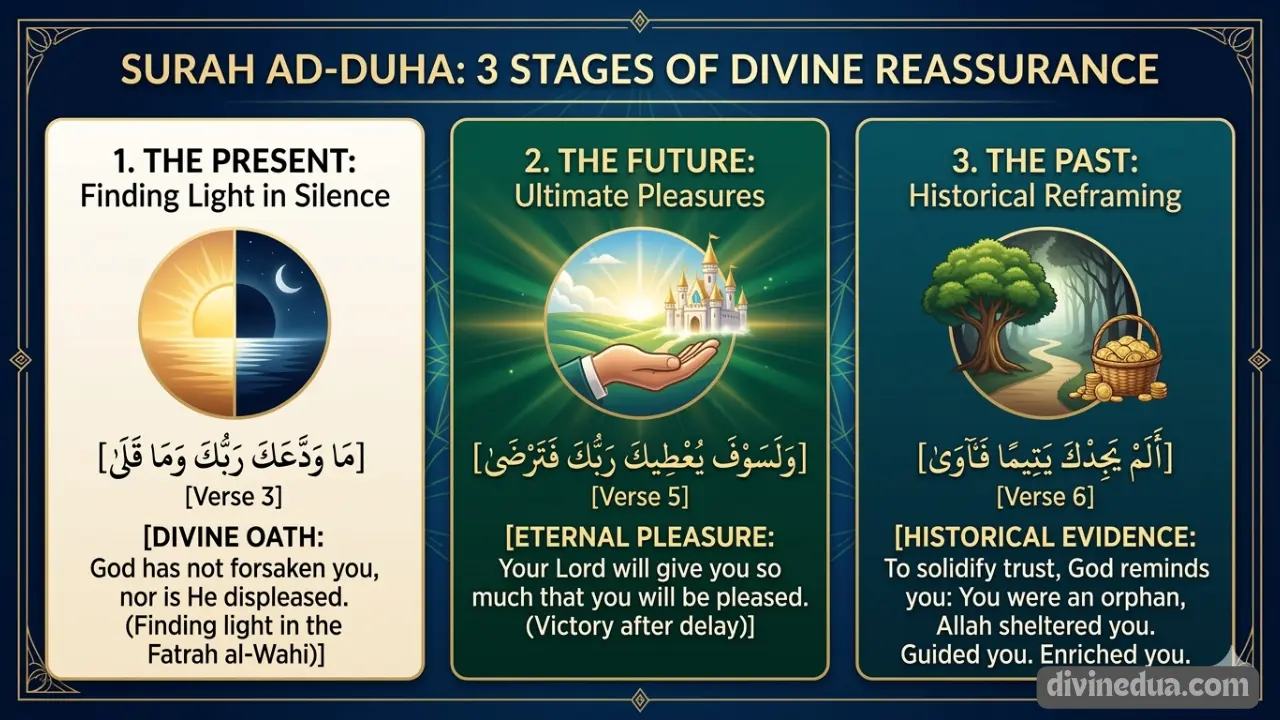
The Tafsir leads to a powerful theological deduction: The God who meticulously took care of you in your most vulnerable past will certainly not abandon you in your current or future trials. This historical reframing is a vital tool for any believer navigating their own period of spiritual darkness, providing a bridge between ancient scripture and modern psychological resilience.
The Tradition of Takbir: Linking Ad-Duha to the Quranic Conclusion
A highly specialized, yet deeply moving aspect of Quranic sciences directly involving Surah Ad-Duha is the established Tradition of Takbir (the vocalization of “Allahu Akbar”). In the rigorous science of Qira’at (authenticated methods of recitation), particularly in the transmission of the Makkan reciter Ibn Kathir via Al-Bazzi, there is an unbroken practice of reciting the Takbir at the end of every Surah, beginning specifically from the conclusion of Surah Ad-Duha and continuing through to the final chapter of the Quran, Surah An-Nas.
The historical origin of this practice is a direct reflection of the psychological resilience and profound joy experienced by the Prophet ﷺ when the agonizing period of Fatrah al-Wahi finally ended. According to the tradition, when Jibril finally appeared and began reciting the opening oaths of Ad-Duha, the Prophet ﷺ, overwhelmed by the realization that he had not been abandoned, spontaneously proclaimed “Allahu Akbar” in a burst of sheer relief and triumph. To this day, reciters echo this Takbir to ritually reenact the triumph of divine light over the darkness of silence, creating a perpetual echo of the Prophet’s ﷺ joy at the return of revelation.
Spiritual Synthesis: The Anatomy of Waiting
The profound genius of linking the biography of Zayd ibn Arqam with the exegesis of Surah Ad-Duha lies in the striking spiritual symmetries that emerge. By synthesizing these elements, we can formulate a spiritual dryness solution for any modern believer navigating their own “night” of the soul. This synthesis is built on three pillars:
- The Anatomy of Waiting: Both Zayd ibn Arqam and Prophet Muhammad ﷺ experienced the agonizing trial of silence, doubt, and communal rejection. Their stories teach us that a delay in divine response unequivocally does not equate to divine rejection or abandonment. Silence is often a necessary crucible designed to forge supreme patience, build unshakeable reliance (Tawakkul), and prepare the soul for a greater elevation.
- The Metaphor of the Heat: Zayd’s transmission regarding the “young camels feeling the heat” (Tarmathu al-Fisal) provides a blueprint for resilience. It indicates that turning to Allah—becoming a true member of the Awwabin (the perpetually returning)—is most valuable precisely when the “heat” of the world is at its peak. True devotion is proven not during quiet moments, but when we intentionally pause amidst high-stress commerce and daily distractions to stand before the Divine.
- Historical Reframing: Just as Surah Ad-Duha instructs the Prophet ﷺ to catalog his past blessings (shelter, guidance, and sufficiency), we must use our personal history as empirical evidence of Allah’s care. The theological deduction is rational: The God who meticulously took care of you in your most vulnerable past will not abandon you in your current turbulence.
By adopting the character of Zayd—who waited in his home for his truth to be recognized—and the perspective of Ad-Duha—which promises a future better than the past—the believer transforms “waiting” from a passive state of sorrow into an active state of spiritual fortification. This is the ultimate synthesis of history, law, and the soul, ensuring that Ghaflah (heedlessness) is replaced by constant divine connection.
The Lexicon of Supplication: Divine Tools for the Soul and Distress
To fulfill the practical and spiritual needs of the reader, and to solidify the topical authority of the “Divine Dua” blog, it is imperative to provide highly authenticated supplications for distress. This section curates the most powerful Duas, beginning with the profound prayer narrated by Zayd ibn Arqam himself, followed by specific prophetic supplications designed to combat the exact types of anxiety, depression, and spiritual lethargy discussed in the exegesis of Ad-Duha.
Understanding these powerful Duas for anxiety requires moving beyond mere recitation to deep, cognitive internalization of their theological mechanisms. Below is the complete, curated compendium for immediate implementation in your daily life:
| Supplication & Purpose | Arabic Text & Transliteration | Meaning & Source |
|---|---|---|
| Zayd ibn Arqam Dua Refuge from Sloth & Incapacity |
اللَّهُمَّ إِنِّي أَعُوذُ بِكَ مِنَ الْعَجْزِ وَالْكَسَلِ وَالْجُبْنِ وَالْبُخْلِ وَالْهَرَمِ وَعَذَابِ الْقَبْرِ اللَّهُمَّ آتِ نَفْسِي تَقْوَاهَا وَزَكِّهَا أَنْتَ خَيْرُ مَنْ زَكَّاهَا أَنْتَ وَلِيُّهَا وَمَوْلَاهَا. Allahumma inni a’udhu bika minal-ajzi wal-kasali wal-jubni wal-bukhli wal-harami wa ‘adhabil-qabr. Allahumma ati nafsi taqwaha wa zakkiha anta khayru man zakkaha… |
“O Allah, I seek refuge in You from incapacity, sloth, cowardice… O Allah, grant my soul righteousness.” Sahih Muslim 2722 |
| Relief of Ad-Duha Anxiety & Sorrow |
اللَّهُمَّ إِنِّي أَعُوذُ بِكَ مِنَ الْهَمِّ وَالْحُزْنِ وَالْعَجْزِ وَالْكَسَلِ وَالْبُخْلِ وَالْجُبْنِ وَضَلَعِ الدَّيْنِ وَغَلَبَةِ الرِّجَالِ. Allahumma inni a’udhu bika minal-hammi wal-huzni wal-ajazi wal-kasli wal-bukhli wal-jubni wa dala’id-dayni wa ghalabatir-rijal. |
“O Allah, I take refuge in You from anxiety, sorrow, weakness, laziness, and the burden of debts.” Sahih Al-Bukhari |
| Dua of Absolute Trust Tawakkul & Sufficiency |
حَسْبِيَ اللَّهُ لَا إِلَهَ إِلَّا هُوَ عَلَيْهِ تَوَكَّلْتُ وَهُوَ رَبُّ الْعَرْشِ الْعَظِيمِ. Hasbiya Allahu la ilaha illa huwa ‘alayhi tawakkaltu wa huwa rabbul-‘arshil-‘azim. |
“Allah is enough for me. There is no true god but Him, in Him I put my trust…” Sunan Abi Dawud |
| Dua of Prophet Yunus For Sudden Distress |
لا إلهَ إلا أنتَ سُبْحَانَكَ إِنِّي كُنْتُ مِنَ الظّالِمِيْنَ. La ilaha illa Anta, Subhanaka, inni kuntu mina z-zalimin. |
“There is no deity but You. Glory be to You! Verily, I have been among the wrongdoers.” Quran 21:87 |
| Dua for Al-Afiyah Complete Well-being |
اللَّهُمَّ إِنِّي أَسْأَلُكَ الْعَافِيَةَ فِي الدُّنْيَا وَالآخِرَةِ، اللَّهُمَّ إِنِّي أَسْأَلُكَ الْعَفْوَ وَالْعَافِيَةَ فِي دِينِي وَدُنْيَايَ وَأَهْلِي وَمَالِي، اللَّهُمَّ اسْتُرْ عَوْرَاتِي وَآمِنْ رَوْعَاتِي، اللَّهُمَّ احْفَظْنِي مِنْ بَيْنِ يَدَيَّ وَمِنْ خَلْفِي وَعَنْ يَمِينِي وَعَنْ شِمَالِي وَمِنْ فَوْقِي، وَأَعُوذُ بِعَظَمَتِكَ أَنْ أُغْتَالَ مِنْ تَحْتِي. Allahumma inni as’aluka al-‘afiyah fi al-dunya wa-al-akhirah. Allahumma inni as’aluka al-‘afwah wa-al-‘afiyah fi dini wa-dunyaya wa-ahli wa-mali. Allahumma ustur ‘awrati wa-amin raw’ati. Allahumma ihfazni min bayni yadayya wa-min khalfi wa-‘an yamini wa-‘an shimali wa-min fawqi, wa-a’udhu bi-‘azamatika an ughtala min tahti. |
“O Allah, I ask You for well-being… guard me from in front, behind, right, left, above, and below.” Sunan Abi Dawud |
The Theological Mechanism: Why These Prayers Work
The first supplication, narrated directly by Zayd ibn Arqam, is a masterclass in psychological self-preservation. When we seek refuge from “incapacity” (Al-Ajz) and “sloth” (Al-Kasal), we are attacking the very root causes that prevent a believer from standing for the Duha prayer. Sloth is the lack of willpower despite having the capacity. By asking Allah to “purify the soul,” the believer acknowledges that spiritual energy—the ability to pause mid-morning—is a divine gift, not merely a product of human discipline.
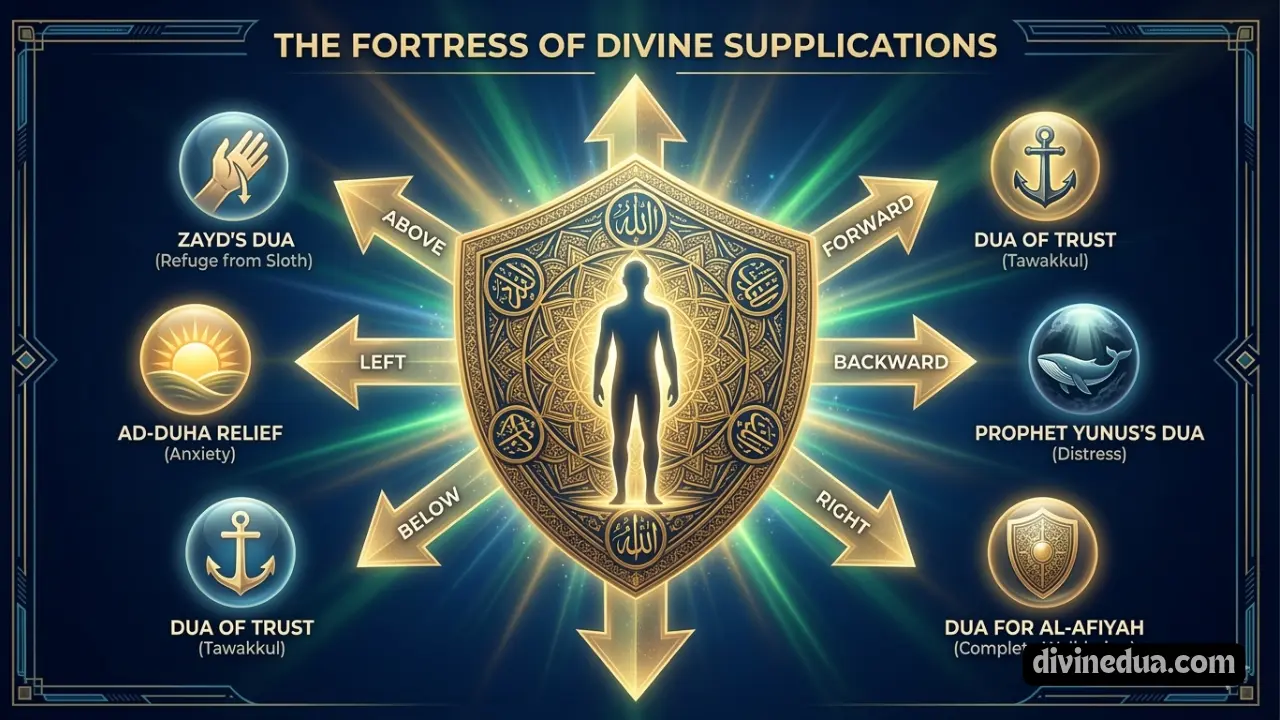
Similarly, the Dua for Al-Afiyah complements the physical purity of prayer. By asking for protection from all six physical directions—front, behind, right, left, above, and below—the believer constructs an impenetrable, divinely ordained spiritual fortress. This ensures that the clarity and connection achieved during the mid-morning prayer are protected against sudden afflictions, social ruins, and spiritual ambushes that characterize the remainder of the day.
Furthermore, the Dua of Absolute Trust and the Dua of Prophet Yunus represent the pinnacle of Tawakkul. Relinquishing the illusion of control—as Zayd did during his isolation and the Prophet ﷺ did during Fatrah al-Wahi—shrinks worldly problems to their significant scale. Calling from the “darkness” mirror the stillness of the night sworn upon in Ad-Duha, admitting one’s shortcomings before divine mercy is unlocked. By anchoring these grand theological narratives with such practical tools, we bridge the gap between historical scholarship and your immediate, daily connection with the Divine.
Conclusion: Finding Light in the Darkness
The construction of this authoritative guide around the query “Zayd ibn Arqam Surah Ad-Duha” demands far more than just historical facts; it requires the deliberate interlacing of vivid biography, rigorous jurisprudence, and profound exegesis. We have learned that divine silence is frequently a tool of mercy and neurological preservation, and that our most virtuous prayers are offered when the “heat” of the world is most intense and suffocating. By adopting the character of Zayd—the Truthful Companion—and the promise of Ad-Duha—the Morning Brightness—your heart remains resilient, no matter how long the silence may last.