

Why Some Duas Are Not Answered: 7 Reasons and the Beauty of Divine Timing
There is a unique kind of ache that comes from sitting on your prayer mat, hands raised and heart trembling, only to feel as though your words are echoing in a silent room. You’ve prayed, you’ve cried, and you’ve waited—yet the answer you so desperately seek hasn’t arrived. In those quiet moments of vulnerability, it is natural for the soul to whisper: “Is my dua rejected?”
If you are feeling frustrated or disconnected, please know this: you are not alone. The feeling of “silence” from the Heavens isn’t necessarily a sign of a closed door; often, it is a sign of a profound process happening behind the scenes. However, it is also essential to reflect and see if there are specific obstacles to dua that might be hindering our connection with Allah (SWT).
Searching for the reasons dua not answered is not a sign of weak faith; rather, it is a sign of a heart that wants to do things right. In Islam, we are taught that Allah is As-Sami’ (The All-Hearing) and He is closer to us than our jugular vein. So, if the response is delayed, there is always a “Why.”
In this guide, we will explore the 7 common reasons why dua is not accepted in the way we expect, the spiritual blocks we might be overlooking, and the profound wisdom behind why Allah might delay His response to bring you something even better.
Why Are Some Duas Not Answered?
While it may feel like silence, some duas remain unanswered due to specific spiritual obstacles, such as a lack of sincerity (Ikhlas), impatience (Al-Istia’jal), or consuming unlawful (Haram) income. However, in Islam, a sincere dua is never truly rejected; it is answered in one of three ways: an immediate response, a delayed response for a more wisdom-filled timing, or by averting a calamity of equal measure. Understanding the etiquette of dua and removing these blocks is essential for spiritual breakthrough.
⚠️ Quick Checklist: Common Blocks to Your Dua
Before diving into the details, check if any of these spiritual barriers are currently affecting your prayers:
- ✕ Lack of Focus (Ghaflah): Making dua while your mind is elsewhere.
- ✕ Rushing the Outcome (Al-Istia’jal): Demanding an immediate answer and losing patience.
- ✕ Asking for Something Sinful: Requesting something that involves harm or breaking family ties.
- ✕ The Heart-Tongue Disconnect: Praying without sincere intention or emotional presence.
- ✕ Persistence in Major Sins: Blocking the blessings of Allah through unrepented actions.
In This Guide, You Will Learn:
Is My Dua Rejected or Just Delayed? Understanding the 3 Outcomes
The first step to healing your relationship with your Creator is to fundamentally change how you define an “answered” prayer. Often, we fall into the trap of thinking that if we don’t see the specific result we asked for, the door is closed. But in the Divine Kingdom, rejection is not the default.
To understand why your dua is not accepted in the way you imagined, we must look at the profound promise made by the Prophet Muhammad (ﷺ). He taught us that for a believer who asks without sin or severing family ties, Allah (SWT) always grants one of three beautiful outcomes.
“There is no Muslim who supplicates with a dua in which there is no sin or severing of family ties, but Allah will give him one of three things: either He will hasten his response, or He will store it for him in the Hereafter, or He will divert an equivalent evil from him.”
This means your dua is never wasted. It is simply transformed into the form that benefits you most. Here is a breakdown of these three Divine responses:
-
1. The Immediate Response:
Allah grants you exactly what you asked for, at the time you asked for it. This is the “Hasten” response we all hope for. -
2. The Eternal Investment:
Allah delays the answer because He has prepared something far greater for you in the Hereafter. On the Day of Judgment, when a believer sees the reward for their “unanswered” duas, they will wish none of their earthly requests had been granted immediately. -
3. The Divine Shield:
You might be asking for a specific job or a life path, but Allah sees a calamity heading your way. Instead of giving you that job, He uses your dua to block that harm, protecting you in ways you cannot perceive.
So, before you ask “is my dua rejected?”, remember that your words have already been heard. The question isn’t if He will answer, but how His wisdom will manifest that answer in your life.
7 Major Reasons Why Some Duas Are Not Answered
Self-reflection is the first step toward spiritual growth. If you feel a barrier between your heart and the Heavens, it is time to look inward. Here are the 7 primary obstacles to dua that may be hindering your response:
1. Lack of Sincerity (Ikhlas)
Dua is not just a collection of words; it is an act of worship (Ibadah). Sometimes, we make dua as a robotic habit rather than a desperate plea from the soul. When the dua is not accepted, it might be because the heart was not truly directed toward Allah alone. Sincerity means calling upon Him with the absolute conviction that only He can bring ease to your hardship.
2. Being Impatient (Al-Istia’jal)
Human nature often leans toward haste, but with Allah, timing is everything. The Prophet (ﷺ) warned us about the “I prayed but nothing happened” trap. Impatience is a major obstacle to dua; the moment you say, “I made dua but it wasn’t answered,” and then stop praying, you close the very door you were knocking on.
3. Consuming Haram Income
This is perhaps one of the most critical reasons dua not answered. Our physical state affects our spiritual reception. There is a famous Hadith about a traveler who raises his hands to the sky crying “O Lord, O Lord,” but his food is haram, his drink is haram, and his clothing is haram.
How can such a person be answered? (Source: Sahih Muslim). Purity in your sustenance leads to purity in your connection with Allah.
4. Making Dua Without Presence of Heart (Ghaflah)
Are you truly focused when you speak to Allah, or is your mind wandering through your “to-do” list? Allah does not answer a dua from a “distracted and heedless heart.” Presence of heart (Hudur al-Qalb) is the soul of dua. If you aren’t listening to your own words, why should they reach the Heavens?
5. Asking for Something Harmful or Sinful
Sometimes, Allah’s “No” is actually a “Protection.” We might unknowingly ask for something that would bring us misery, lead us away from our faith, or cause harm to others. Allah, in His infinite mercy, denies the request to save us from our own limited understanding.
6. Severing Family Ties
Islam places immense importance on family bonds. Breaking ties with relatives (Qat’ al-Rahim) creates a spiritual blockage. If your relationships with your parents or siblings are broken without a valid reason, it can be a direct cause of why dua is not accepted. Repairing these ties often opens the gates of sustenance and answered prayers.
7. Giving Up Too Early (Lack of Persistence)
Allah loves the “Al-Mulihheen”—those who are persistent in their dua. He loves to hear your voice again and again. Sometimes, the answer is delayed simply because Allah wants you to keep calling upon Him, drawing you closer to Him through the very struggle you are trying to escape.
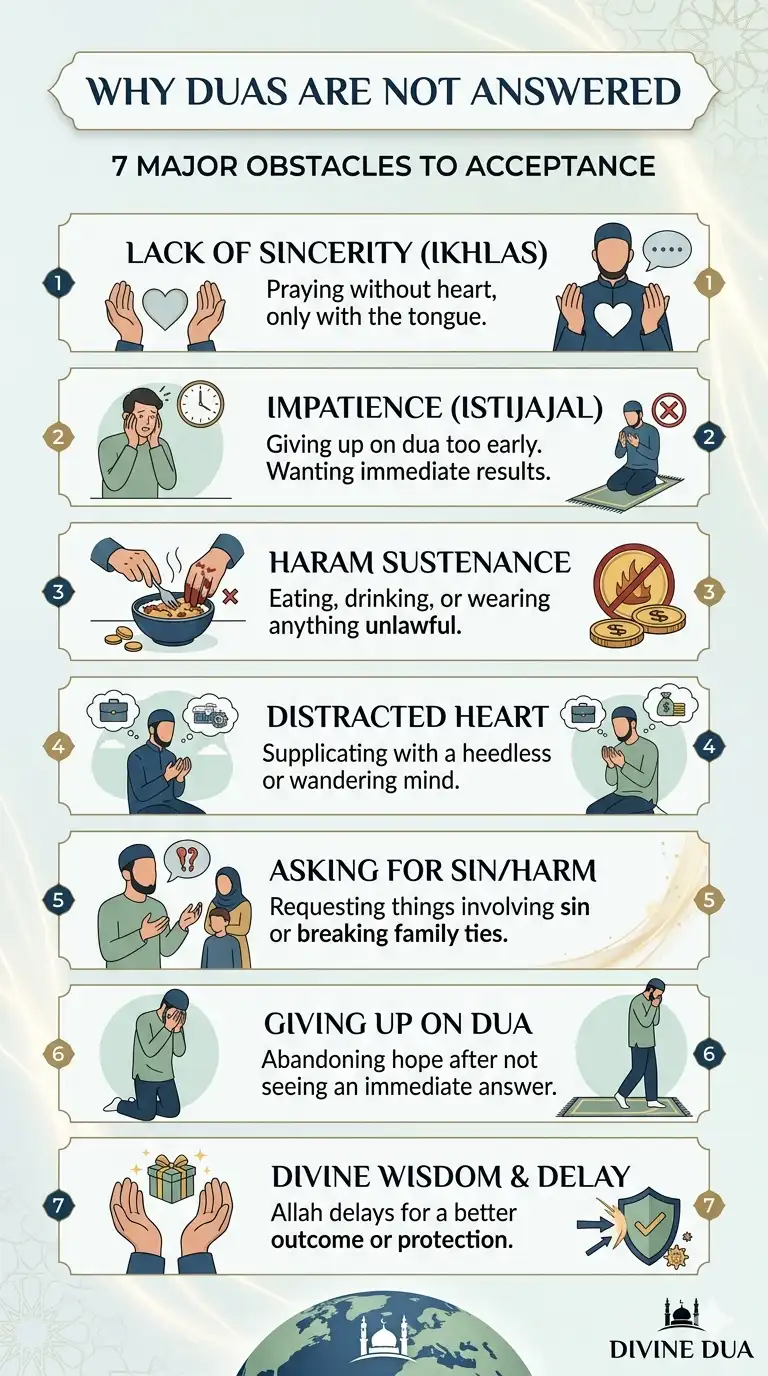
Feel free to save and share this infographic as a spiritual reminder.
The Divine Wisdom: Why Allah Delays the Answer
One of the most profound realizations a believer can have is that Allah’s “No” is often a hidden “Yes” to something much greater. When you feel that your dua is not accepted, it is not because Allah is unaware of your pain, but because His wisdom far surpasses our limited human perspective.
Understanding the reasons dua not answered immediately requires looking at the “Divine Timing” through these three spiritual lenses:
1. A Test of Your Sabr (Patience) and Tawakkul (Trust)
True faith is not just believing in Allah when everything goes your way; it is trusting Him when the answer is delayed. By withholding the response, Allah is giving you a golden opportunity to strengthen your Tawakkul. He wants to see if you will turn away in frustration or if you will knock on His door even harder. Remember, the tighter the knot, the closer the relief.
2. Maximizing Your Reward (Dua is Ibadah)
In Islam, the act of making dua is, in itself, a form of worship (Ibadah). Every time you raise your hands and say “Ya Allah,” you are earning rewards and wiping away sins. If Allah answered every prayer instantly, we might stop calling upon Him. By delaying the answer, He keeps you in a state of Zikr (remembrance), accumulating mountains of rewards that you will only truly appreciate in the Hereafter.
3. Protection from an Unknown Evil
We often pray for “A” (a specific job, a person, or a path), thinking it is the ultimate source of our happiness. However, Allah knows that “A” might eventually lead to our downfall or spiritual ruin. As the Quran beautifully states:
“Perhaps you hate a thing and it is good for you; and perhaps you love a thing and it is bad for you.” (Source: Surah Al-Baqarah 216).
Reflective Thought: Think of a time in your past when you desperately wanted something that didn’t happen—only to realize months or years later that you were being saved from a major disaster. That was Allah’s mercy in the form of a “delay.”
Your 5-Minute Checklist Before Making Dua (The Etiquette)
If you feel that your dua is not accepted, perhaps it is time to look at your “spiritual protocol.” Just as we prepare ourselves before a formal meeting, our conversation with the King of Kings requires a specific state of heart and mind.
Try this 5-minute checklist before your next prayer to ensure you are following the etiquette of dua correctly:
-
1
Start with the Praise of Allah (Tahmid):
Don’t jump straight into your needs. Begin by acknowledging His greatness. Say “Alhamdulillah” and “SubhanAllah.” Recognizing His blessings is the key to receiving more. -
2
Send Blessings upon the Prophet (ﷺ):
Scholars mention that a dua is suspended between heaven and earth until Salawat is sent upon the Prophet (ﷺ). It is the fuel that helps your prayer ascend. -
3
The “Cleaning” Stage (Istighfar):
Admit your sins and seek forgiveness. Think of Istighfar as cleaning the vessel of your heart so it is ready to receive the “pure water” of Allah’s blessings. -
4
Face the Qiblah and Raise Your Hands:
This physical act of humility is powerful. It signals to your brain and soul that you are in a state of begging from the Only One who can give. -
5
Ask with “Yaqeen” (Certainty):
Never say “O Allah, give me if You want.” Ask with the absolute conviction that Allah is listening and that the answer is already on its way. Uncertainty is one of the silent obstacles to dua.
Pro Tip: Try to find a quiet place, even if it’s just for these 5 minutes. Silence outside helps create the focus (Hudur) you need inside.
How to Make Your Dua More Effective
Now that you understand the reasons dua not answered and the common obstacles to dua, the question is: how can you truly optimize your connection with Allah? Mastering the etiquette of dua is the foundation, but there are specific “boosters” that can make your prayers more powerful.
Timing is Everything
Did you know there are specific windows where the gates of Heaven are wide open?
Check our guide on the Best Times for Dua Acceptance to ensure you are praying during these blessed moments.
Another essential pillar is fulfilling the conditions of dua through active worship. If you have a very specific or urgent need, the Sunnah provides us with a dedicated prayer designed to seek Allah’s direct intervention.
For Specific Needs
When a situation feels impossible, turn to the prayer of need.
Learn How to Perform Salatul Hajah and combine it with your heartfelt supplications.
Ultimately, the bridge between your request and the answer is Tawakkul (Complete Reliance on Allah). When you align your heart with the right etiquette of dua and leave the result to His wisdom, you find a peace that is even greater than the answer itself.
Frequently Asked Questions About Dua Acceptance
Can my sins block my dua forever?
Absolutely not. While persistent sins can be one of the reasons dua not answered, they are never a permanent barrier. The door of Taubah (Repentance) is always open. In fact, Allah may delay the answer to your dua specifically to lead you back to Him in repentance. Once you turn back with a sincere heart, the blockage is lifted. Remember, Allah’s mercy is far greater than any mistake you have made.
How do I know if Allah is angry with me or just testing me?
The answer lies in the state of your heart. If the delay in your dua makes you more humble, brings you closer to the prayer mat, and increases your longing for Allah, then it is a blessed test designed to elevate your rank. However, if the delay makes you bitter, arrogant, or causes you to abandon your prayers, then it is a sign that your heart needs urgent realignment. A test is meant to polish the soul, not break the faith.
Why do non-believers have their wishes granted while my dua is delayed?
This is a common source of confusion, but it is explained through the concept of Dunya vs. Akhirah. For those who do not seek the Hereafter, Allah may grant them their full reward in this world (Dunya). For the believer, Allah saves the best for the Akhirah. Think of it this way: a guest is given a quick snack to keep them quiet, while the beloved friend is made to wait a little longer for a grand, multi-course feast. Your delay is a sign that you are being prepared for the “feast” of the Hereafter.
Final Thoughts: Trusting the Most Wise
As we close this guide, let this one truth settle deep within your soul: Your dua is never wasted. Every word you whisper in the dark, every tear that falls on your prayer mat, and every sigh of exhaustion you breathe is witnessed by the One who created you.
In the Divine Kingdom, there is no such thing as a “deleted” prayer. There are only prayers that are answered now, prayers that are saved as treasures for your hereafter, and prayers that are transformed into shields of protection. The obstacles to dua we discussed aren’t meant to discourage you, but to help you polish your heart so that your connection with Allah becomes even more beautiful and sincere.
Never stop knocking on the door of Allah. Even if the answer feels far away, remember that the knock itself is a form of success.
Join the Conversation
Which of the 7 reasons we discussed today resonated with you the most? Have you ever experienced a “delayed” dua that turned out to be a blessing in disguise?
Share your thoughts in the comments below—your story might be exactly what someone else needs to hear today.