

One of the most beautiful aspects of Islam is the direct, heart-to-heart connection between a believer and their Creator. However, for many Muslims—especially those who are new to the faith or do not speak Arabic fluently—a common question often arises: “Can you make dua in English?”
You might feel a sense of hesitation, wondering if your prayers are “lesser” because they aren’t in the language of the Quran, or if Allah will accept a heart that speaks a different tongue. It is completely natural to want your supplications to be perfect, but this worry shouldn’t create a barrier between you and your Lord. If you’ve been concerned about making dua in English or feeling like you must wait until you learn Arabic to truly connect, we have some reassuring news for you.
Allah is the Creator of all languages and the Knower of what is hidden deep within every soul. While learning how to make dua properly is a beautiful goal for every Muslim, the essence of worship is sincerity. Islam is a religion of ease, and the ability to express dua in your own language is a mercy that allows you to call upon Him at any moment, in any state.
Whether you are a revert or someone simply more comfortable making dua in English, your words are heard. Allah does not look at the eloquence of the tongue, but at the purity of the heart.
In this guide, you will learn whether making dua in English is allowed in Islam, what scholars say about it, and how to make sincere dua in any language.
Can You Make Dua in English in Islam?
Yes, you can make dua in English or any language you are comfortable with.
Allah is the Creator of all languages and knows what is in your heart even before you speak. In Islam, the validity of your dua is based on your sincerity and intention rather than the language used.
While it is recommended to learn and use the beautiful, authentic duas from the Quran and Sunnah in Arabic over time, your heartfelt making dua in English is fully accepted and encouraged.
⚡ Quick Answer: Making Dua in English
-
✔
Yes, making dua in English is fully allowed in Islam. -
✔
Allah is the Creator of all tongues and understands all languages. -
✔
Your sincerity (Ikhlas) is far more important than the specific words used. -
✔
While Arabic duas are recommended (as they are from the Sunnah), they are not required for your prayer to be accepted.
In This Guide, You Will Learn:
- Is it allowed to make dua in English?
- What scholars say about it
- When Arabic is required (The Distinction)
- Examples of simple duas you can use today
- Common mistakes to avoid
- FAQs about dua and language
Is It Allowed to Make Dua in English?
The short and most heart-filling answer is: Yes, it is absolutely allowed. In fact, expressing your needs to Allah in the language you speak daily can often lead to a deeper sense of focus and emotional connection.
Many people worry that their prayers won’t “reach” the heavens if they aren’t in Arabic, but this is a misconception. Islam is a universal faith, and Allah (SWT) is the Creator of all languages. Whether you are making dua in English, Urdu, Spanish, or any other tongue, Allah hears and understands the whispers of your soul.
The core of dua is Ibadah (worship) and communication. Allah does not require a translator to understand His servants; He created the diversity of our speech as a sign of His greatness. Therefore, you should never feel like your prayer is “stuck” or “unaccepted” just because you are using your own words. Understanding the best time to make dua can help you feel even more confident that your sincere English supplications are being heard during those blessed moments.
“Allah is the Creator of all tongues and knows what is hidden deep within every heart. There is no barrier between the Creator and His creation.”
📌 The Evidence: “Allah knows what is in your hearts.”
This means that while the words you speak are important, the sincerity and intent behind those words are what truly matter in the sight of the Almighty.
What Do Scholars Say About Making Dua in English?
When we look at the scholarly consensus on making dua in other languages (the الجمهور – Jumhur), the message is clear and encouraging: making dua in English is permissible and valid. Scholars emphasize that Allah (SWT) wants His servants to call upon Him with a present and attentive heart.
For those who do not yet speak or understand Arabic, scholars actually recommend making dua in your own language. Why? Because the essence of dua is Inkisār (humility and breaking before Allah). If you are simply repeating Arabic words without knowing their meaning, that deep emotional connection might be missing.
For instance, when you are seeking a specific dua for guidance during a difficult time, expressing your pain and hopes in English allows your heart to speak as clearly as your tongue.
📌 Important Clarification: Dua Inside Salah
While general dua (outside of formal prayer) is open to all languages, scholars make a small distinction for Salah (the 5 daily prayers).
Most schools of thought recommend keeping the obligatory parts of Salah in Arabic. However, if you are in Sajdah (prostration) during a Sunnah or Nafl prayer, many scholars allow you to speak to Allah in your own language if you haven’t yet memorized the Arabic supplications.
The goal is connection, not complication.
In short, do not let your lack of Arabic stop you from talking to your Creator. The doors of His mercy are never locked by a language barrier.
When Is Arabic Preferred in Dua?
While we have established that Allah understands every language, you might wonder: “If English is okay, why do we still emphasize Arabic?” It is a fair question. In Islam, Arabic isn’t just a language; it is the vessel of the Revelation and the tongue of our beloved Prophet (PBUH).
There are two specific situations where using Arabic is highly preferred and recommended:
- Authentic Supplications (Al-Ad’iyah al-Ma’thurah): These are the specific words found in the Quran or spoken by the Prophet (PBUH). These duas are “concise yet profound” (Jawami’ al-Kalim), carrying a spiritual weight and precision that translations sometimes struggle to capture fully.
- Inside the Obligatory Prayer (Salah): As we touched upon earlier, the formal Fard prayers are a universal bond for Muslims worldwide. Keeping the core parts in Arabic preserves the unity and the original form of worship as taught by the Prophet (PBUH).
📌 Finding the Perfect Balance
How should you approach your daily conversation with Allah?
Combine both! Start with the Arabic Sunnah duas (even if you read them from a card) to gain the blessing of following the Prophet, then continue making dua in English to express your personal needs and feelings deeply.
If you haven’t memorized the Arabic yet, dua in your own language only is perfectly valid and accepted. Allah values your presence of heart more than the language of your tongue.
The goal is never to make you feel excluded, but to encourage you to slowly connect with the beautiful language of your faith while keeping your heart wide open in the language you know best.
Why Sincerity Matters More Than Language

In the rush to find the “perfect” words or the “correct” language, we often forget the most fundamental truth about dua: it is an act of the heart before it is an act of the tongue. Islam teaches us that Allah (SWT) is not looking for a linguist; He is looking for a believer who calls upon Him with absolute conviction and need.
The Prophet Muhammad (PBUH) taught us that “Allah does not look at your appearances or your wealth, but He looks at your hearts and your actions.” This principle applies perfectly to making dua in English. If your heart is present, trembling with hope, and fully focused on Allah’s mercy, then your language is secondary. The essence of dua is Ikhlas (sincerity)—the pure intention to seek help from the Only One who can provide it.
Dua is not a ritual of reciting formulas; it is a conversation. When you speak to your Lord, you are showing your vulnerability. Whether you use complex Arabic sentences or simple, broken English, the “sound” that reaches the Heavens is the sincerity of your soul.
💡 A Powerful Thought for Your Journey
“A single, simple sentence whispered in English with a broken heart and tears of sincerity is far more powerful and beloved to Allah than a long, eloquent dua in perfect Arabic recited with a distracted mind and an absent heart.”
Remember, the purpose of dua in your own language is to feel the weight of every word you say. When you say ‘O Allah, help me,’ you should feel it in your chest. That feeling—that connection—is exactly what makes a dua ‘accepted’ (Maqbul).
Beyond Language: The Etiquettes (Adab) of Making Dua

While making dua in English is perfectly acceptable, the spiritual “etiquette” (Adab) remains the same regardless of the language you speak. To ensure your heart is in the right state, follow these timeless Prophetic tips:
- Start with Praise: Before asking for what you need, begin by praising Allah (e.g., “O Allah, You are the Most Merciful, the Provider”).
- Send Blessings on the Prophet: It is a key etiquette to send Salawat (blessings) upon Prophet Muhammad (PBUH) at the start and end.
- Face the Qibla and Raise Your Hands: These physical actions help focus your soul, even if your words are in English.
- Be Certain of the Answer: Make your dua in your own language with full conviction (Yaqeen) that Allah is listening and will respond in the best way.
Examples of Simple Dua in English
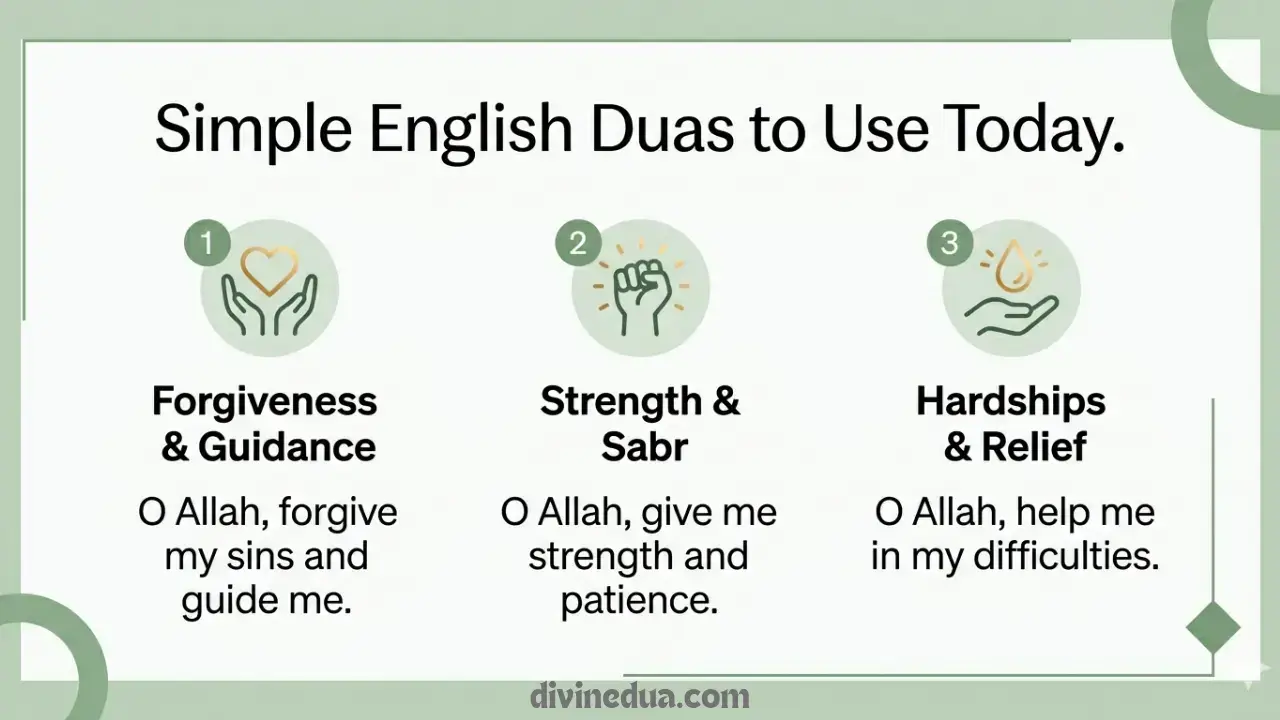
Now that you know your sincerity is what opens the doors of acceptance, let’s put it into practice. You don’t need to wait until you’ve memorized long Arabic phrases to start your conversation with Allah. You can start making dua in English right now, using these simple yet powerful examples.
These are “all-encompassing” supplications that cover the most essential needs of a believer’s life:
For Forgiveness & Guidance
“O Allah, forgive my sins and guide me to the straight path.”
For Strength & Sabr
“O Allah, give me the strength to overcome my trials and grant me patience (Sabr).”
For Hardships & Relief
“O Allah, help me in my difficulties and ease my burdens.”
💥 Action Step: Don’t just read these! Choose one that resonates with your heart right now, close your eyes, and say it sincerely to Allah. He is listening.
Remember, dua in your own language is your personal bridge to your Creator. As you grow in your faith, you can slowly start adding [Arabic Sunnah Duas] to your routine, but never let a lack of Arabic keep you silent.
Can You Mix Arabic and English in Dua?
Absolutely! In fact, mixing Arabic and English—a “hybrid” approach—is one of the most effective ways to build a powerful connection with Allah while honoring the Sunnah. You don’t have to choose one or the other; you can have the best of both worlds.
Many believers find peace in starting their making dua in English journey by using well-known Arabic phrases for praise and then switching to their native tongue for personal requests. Here is a simple way to do it:
- Step 1: The Opening (Arabic) – Start by praising Allah and sending blessings upon the Prophet (PBUH) in Arabic (e.g., Alhamdulillah, Allahumma Salli ala Muhammad).
- Step 2: The Heart (English) – Speak naturally in English about your specific fears, hopes, and needs. This is where your dua in your own language becomes deeply personal.
- Step 3: The Closing (Arabic) – End with a comprehensive Sunnah dua like “Rabbana Atina fid-dunya hasanatan…” if you know it.
🔹 People Also Ask: Is it better to make dua in Arabic or English?
The Answer: Arabic is superior when reciting the specific “Masnoon” duas (supplications from the Quran and Sunnah) because they carry the exact words of revelation. However, English is better for your personal, heartfelt conversations with Allah if you don’t understand Arabic, as it ensures your heart and mind are fully present in what you are saying.
This balance ensures that you are following the tradition of the Prophet (PBUH) while still maintaining the “human” and emotional side of your prayer.
Teaching Children and Reverts: The Power of Personal Dua
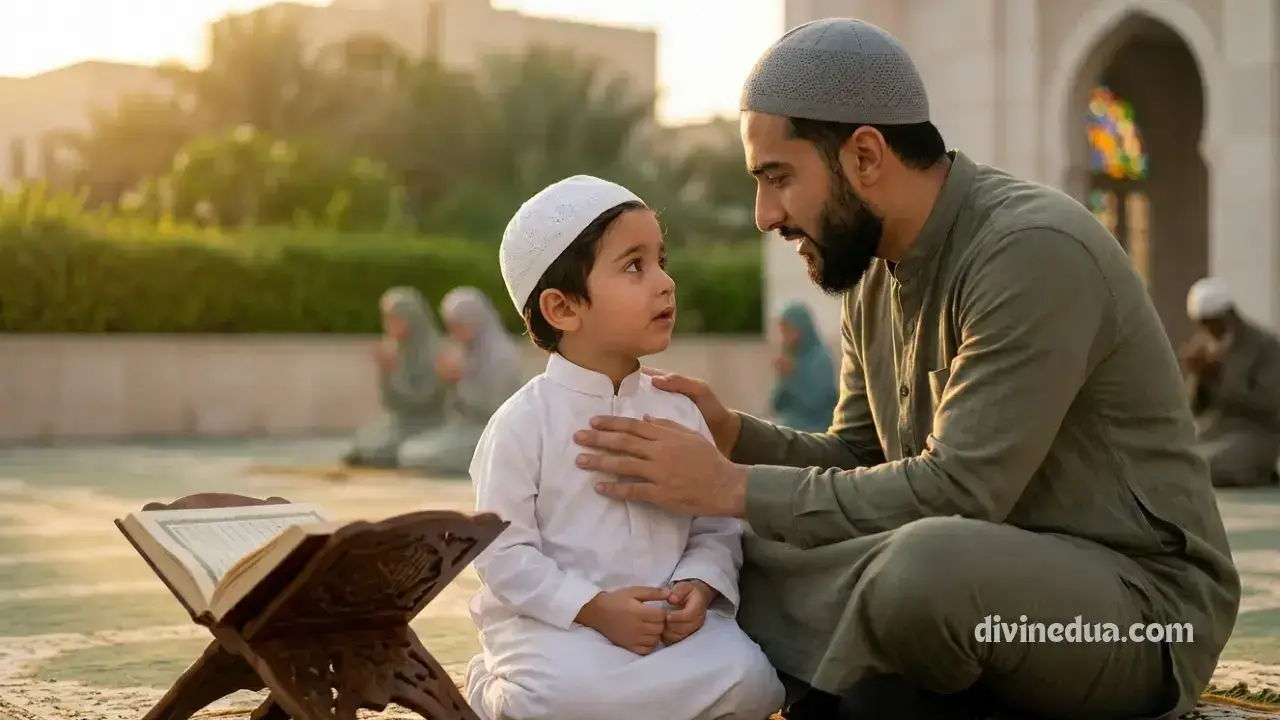
For parents and those welcoming new Muslims into the community, encouraging making dua in English is a powerful tool for spiritual growth. When a child or a revert talks to Allah in their native tongue, it removes the “formality” and builds a personal relationship with the Creator.
Pro Tip: Encourage your children to tell Allah about their day, their fears, and their small joys in English. This teaches them that Allah is always near, always listening, and that He is their best friend in every situation.
The Psychological Power of Praying in Your Native Tongue
There is a unique emotional release and many psychological and spiritual benefits of Dua that happen when you speak to Allah in the language you think and dream in. Making dua in English allows you to express complex emotions, subtle pains, and deep-seated hopes that you might not yet have the Arabic vocabulary for.
Psychologically, this “unfiltered” communication helps in:
- Emotional Healing: Pouring out your heart during difficult times without struggling for words.
- Mindfulness: Being fully “present” in your prayer instead of just reciting memorized phrases.
- Mental Clarity: Organizing your thoughts while seeking Allah’s guidance in your native tongue.
Common Mistakes When Making Dua in English
Sometimes, our own worries or lack of knowledge can create unnecessary barriers in our worship. To ensure your making dua in English is as powerful and effective as possible, let’s look at some common pitfalls to avoid:
❌ Mistake #1: Thinking Dua Must Be in Arabic
Many people remain silent because they haven’t mastered Arabic yet. Remember: Allah created your native tongue. Staying silent out of fear is a bigger mistake than speaking to Him in English.
❌ Mistake #2: Not Being Sincere (Lack of Ikhlas)
Dua isn’t a “magic spell” or a list of demands. Whether you use English or Arabic, if your heart isn’t present, the essence of the worship is lost. Focus on the dua in your own language with full conviction.
❌ Mistake #3: Copying Words Without Understanding
It’s better to say a few words in English that you truly feel, rather than reciting a 10-minute Arabic dua where you don’t understand a single word. Allah wants you, not just your voice.
❌ Mistake #4: Giving Up Quickly
Some feel that because they aren’t using the “sacred language” (Arabic), their dua might take longer to be answered, so they stop. Consistency is key. Keep knocking on Allah’s door; He never turns away a sincere caller.
By avoiding these mistakes, you ensure that your connection with Allah remains pure, direct, and full of life.

Can Allah Understand All Languages?
Yes, without a doubt. Allah (SWT) is the Creator of all mankind and the Originator of every tongue. In the Quran, He mentions that the diversity of our languages and colors is a sign of His greatness (Surah Ar-Rum, Verse 22). He does not need a language to understand you; He knows the whispers of your soul before you even speak them in English.
Is making dua in English “less powerful” than Arabic?
Never. The “power” of a dua comes from the power of Allah and the sincerity of the believer. A dua is powerful when it is made with full certainty (Yaqeen), a humble heart, and a focused mind. Whether those feelings are expressed in English or Arabic, they reach the same Lord who promises: “Call upon Me; I will respond to you” (Surah Ghafir, 60).