
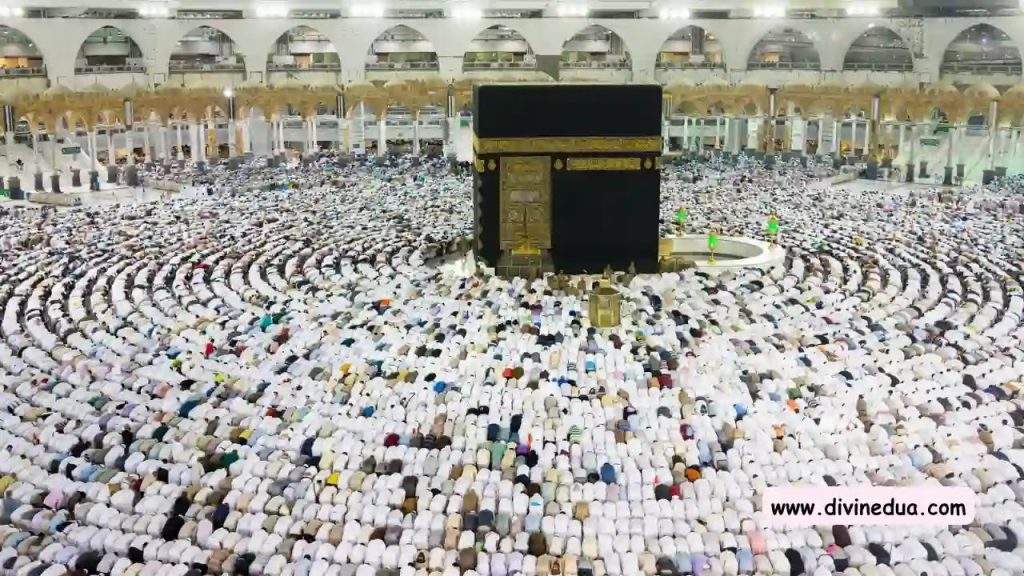
How to Perform Hajj: A Step-by-Step Spiritual & Practical Guide
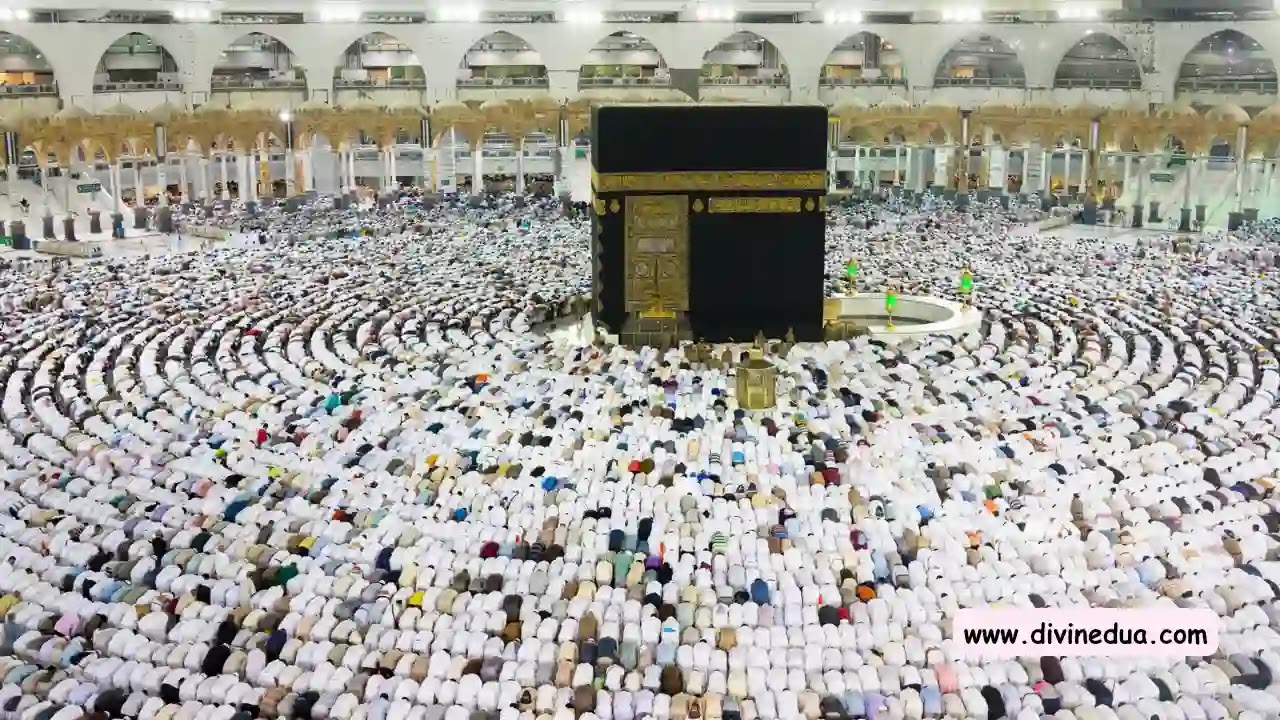
The call to Hajj is an invitation from Allah to embark on the most profound journey of a lifetime. It is a pilgrimage that cleanses the soul, erases sins, and connects you to millions of hearts beating as one. But this journey does not begin when you board the plane; it begins months before, in the quiet moments of preparation. This guide is designed to be your companion, taking you step-by-step through the spiritual, physical, and practical preparations for this blessed pillar of Islam.
Part 1: Hajj Preparation – The Journey Before the Journey
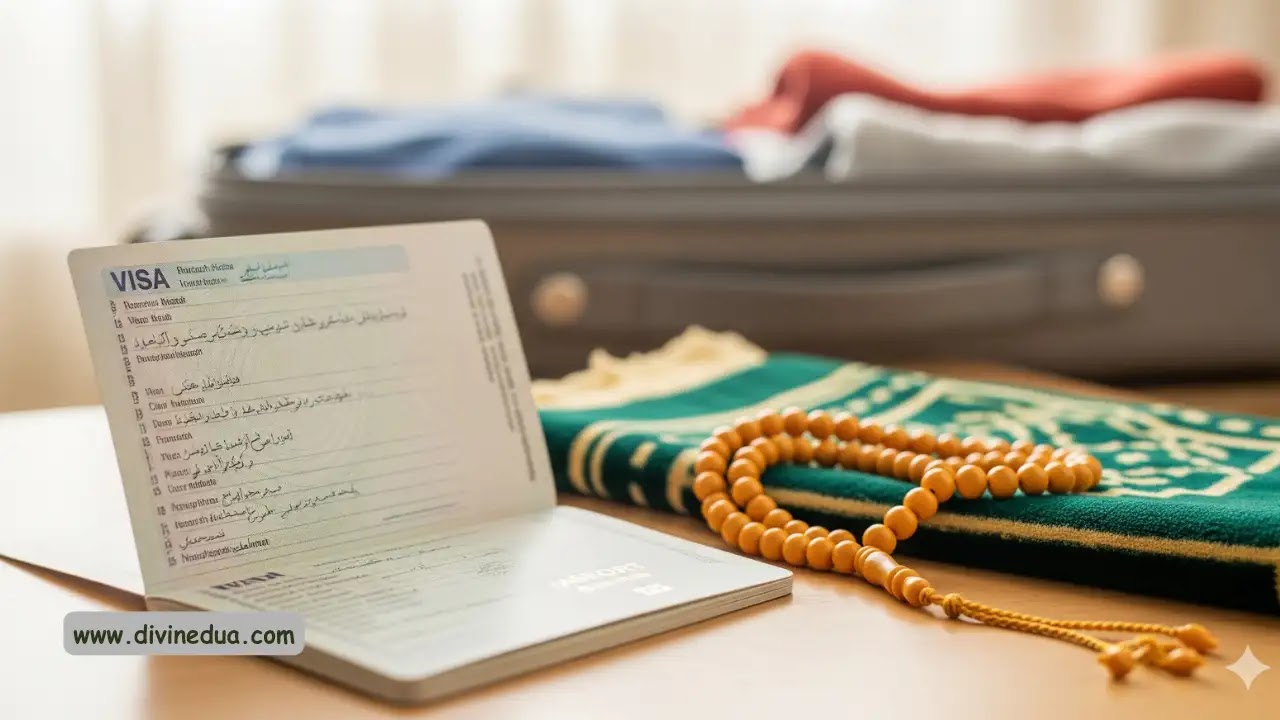
Proper Hajj preparation is the key to a focused and accepted Hajj. Before you pack your bags, you must first prepare your heart. This initial phase is crucial, as it sets the foundation for your entire pilgrimage. There are no specific words or duas to recite during this phase, but the actions themselves are a form of worship.
A. The Spiritual Preparation: Packing Your Heart First
Before you think about what to pack for Hajj, focus on purifying the vessel that will undertake this journey: your soul. Here is your spiritual preparation for Hajj checklist:
- Sincere Repentance (Tawbah): Turn to Allah with a sincere heart, seeking forgiveness for all past sins. A pure heart is the best provision for this journey. This involves stopping the sin, regretting it, and resolving never to return to it.
- Seek Forgiveness from Others: Mending broken relationships is essential. Reach out to anyone you may have wronged—family, friends, or colleagues. Ask for their forgiveness directly to clear any lingering disputes. You want to stand before Allah with a clean slate with His creation.
- Settle Your Debts: One of the conditions for Hajj is that you should be free from major financial obligations. Do your utmost to pay off any outstanding debts before you travel. If you cannot, seek permission from your creditors and document the debts.
- Learn the Rituals: True spiritual preparation for Hajj involves learning the ‘how’ and ‘why’ of each ritual. Understanding the significance of Tawaf, Sa’i, and Wuquf at Arafat will transform your actions from mechanical movements to profound acts of worship. Attend seminars or read trusted books on the subject.
B. The Physical Preparation: Training for the Walk of a Lifetime
Hajj is a spiritually uplifting experience, but it is also physically demanding. Proper physical preparation for Hajj will ensure you have the energy to perform your rituals with focus and ease.
- Start Walking Daily: The most important exercise is walking. Aim to walk for at least 30-45 minutes every day in the months leading up to your trip. This will build your stamina for the long walks during Tawaf, Sa’i, and between the holy sites.
- Choose Comfortable Footwear: Purchase a pair of comfortable walking sandals or shoes and “break them in” by wearing them during your daily walks. This will prevent blisters and discomfort in Mecca.
- Stay Hydrated: Get into the habit of drinking plenty of water daily. This will prepare your body for the heat of Saudi Arabia and the importance of staying hydrated with Zamzam.
C. The Ultimate Hajj Packing Checklist
Packing for Hajj requires careful thought. Here is a detailed Hajj checklist to ensure you have everything you need.
Essential Documents & Money:
- Passport, Visa, and Plane Tickets (with photocopies stored separately)
- Vaccination Certificates (as required)
- Passport-sized photos
- Emergency contact information and hotel address
- Saudi Riyals in cash and a debit/credit card
Ihram & Clothing:
- Two sets of Ihram garments (for men)
- Comfortable, modest, and loose-fitting clothing (for women – abayas, hijabs)
- Extra sets of modest clothing for regular days
- Light sweater for cool nights in Muzdalifah
- Comfortable walking sandals and a spare pair
- Small string bag to carry your shoes at the mosque
- Waist pouch or neck pouch for valuables
Health & Toiletries:
- Any personal prescription medications
- Basic first-aid kit (pain relievers, plasters, antiseptic wipes, muscle rub)
- Unscented soap, shampoo, deodorant, and wet wipes (for use during Ihram)
- Scented toiletries for after Ihram
- Sunscreen and lip balm
- Small scissors or nail clippers (for trimming hair after Ihram)
- Travel-sized prayer mat
- Small dua book or notes
Step 1: Niyyah & Ihram – Leaving the World Behind
This is the true beginning of your Hajj. The state of Ihram is a sacred state of purity and devotion that a pilgrim enters at a designated boundary point known as the Miqat. By entering the state of Ihram, you leave behind worldly distractions and adornments, symbolizing your complete submission to Allah.
The concept of Niyyah is so foundational that we’ve covered it in our guide on the essential dua for Niyat.
The intention (Niyyah for Hajj) is the most critical element, as it is the spiritual act of dedicating your Hajj to Allah alone. While the Niyyah resides in the heart, it is a Sunnah to vocalize it. After performing purification (ghusl), you will declare your intention by saying:
لَبَّيْكَ اللَّهُمَّ حَجًّا
Transliteration: “Labbayka Allahumma Hajjan.”
Translation: “O Allah, I answer Your call to perform Hajj.”
The Talbiyah: The Pilgrim’s Anthem
Once you have made your intention, you will begin the constant Talbiyah recitation. This beautiful and powerful chant is the pilgrim’s anthem, a constant affirmation that you are responding to Allah’s call. You will continue to recite it frequently throughout your journey until you begin the stoning ritual on the 10th of Dhul Hijjah.
لَبَّيْكَ اللَّهُمَّ لَبَّيْكَ، لَبَّيْكَ لَا شَرِيكَ لَكَ لَبَّيْكَ، إِنَّ الْحَمْدَ وَالنِّعْمَةَ لَكَ وَالْمُلْكَ، لَا شَرِيكَ لَكَ
Transliteration: “Labbayka Allahumma labbayk, labbayka la sharika laka labbayk. Innal-hamda wan-ni‘mata, laka wal-mulk, la sharika lak.”
Translation: “Here I am, O Allah, here I am. Here I am, You have no partner, here I am. Verily all praise and blessings are Yours, and all sovereignty, You have no partner.”
(Source: Sahih al-Bukhari)
Understanding the Ihram Rules
While in the state of Ihram, certain actions are forbidden to maintain a state of purity and focus. The main Ihram rules include:
- For Men: No wearing of stitched or form-fitting clothing.
- For All: No using perfumes or scented products, no cutting or plucking hair or nails, no engaging in arguments or disputes, and no marital relations.
A Pilgrim’s Diary Entry:
“As I wrapped the two simple, white sheets of Ihram around my body, I felt like I was shedding my entire life. My job title, my status, my worries—they all seemed to dissolve. Reciting the Talbiyah for the first time, with thousands of others, was the most powerful moment. It was a roar of submission, a chorus of souls answering a single call. In that moment, I was no one but a servant, a guest of Allah, and I have never felt more free.”
Step 2: The Tawaf of Arrival & Sa’i
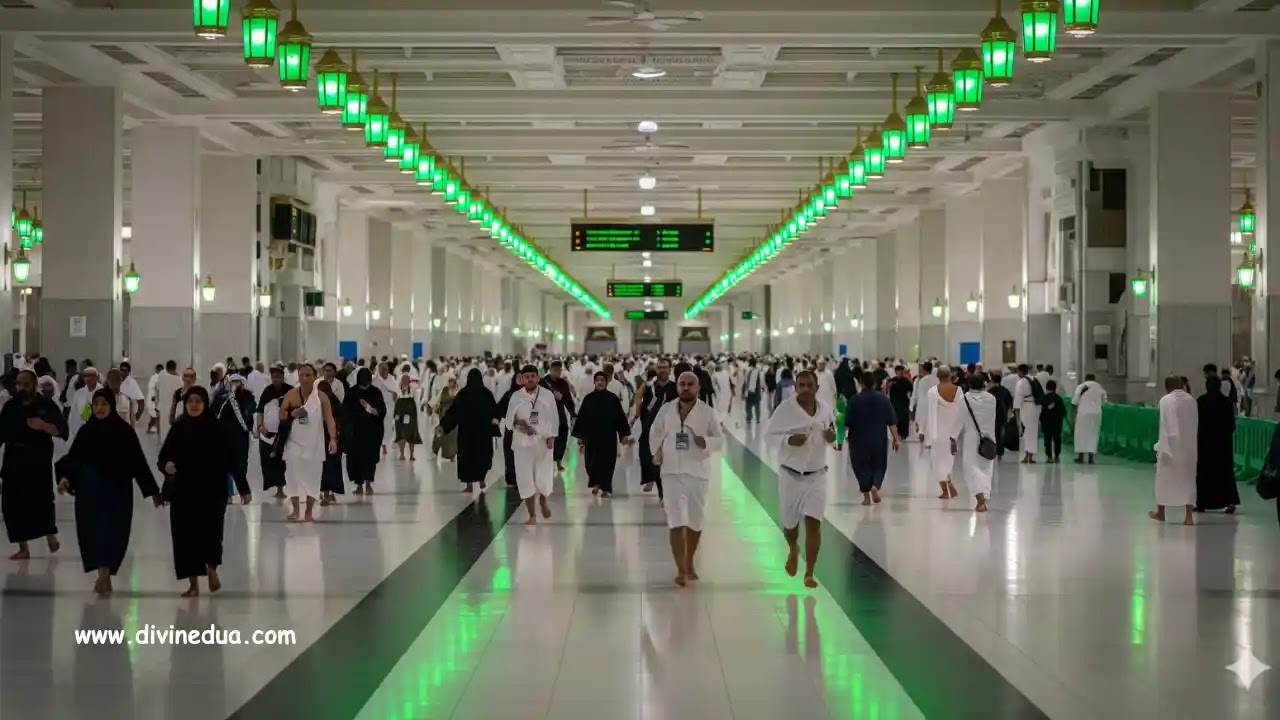
Upon arriving in Mecca, your first major ritual is the Tawaf of Arrival (Tawaf al-Qudum). This is the profound act of performing the Tawaf around the Kaaba seven times. This ritual is a deeply spiritual welcome to the House of Allah, symbolizing the unity of the believers whose lives revolve around Him.
The Tawaf of Arrival (Tawaf al-Qudum)
Your Tawaf begins at the Black Stone (Al-Hajar al-Aswad). As you circle the Kaaba, you are free to recite any supplications from your heart. However, it is a beloved Sunnah to continuously recite the following comprehensive dua between the Yemeni Corner and the Black Stone:
رَبَّنَا آتِنَا فِي الدُّنْيَا حَسَنَةً وَفِي الْآخِرَةِ حَسَنَةً وَقِنَا عَذَابَ النَّارِ
Transliteration: “Rabbana atina fid-dunya hasanatan wa fil-akhirati hasanatan wa qina ‘adhaban-nar.”
Translation: “Our Lord, give us in this world [that which is] good and in the Hereafter [that which is] good and protect us from the punishment of the Fire.”
After completing seven rounds, you will pray two rak’ahs behind Maqam Ibrahim (the Station of Abraham). Following this, you proceed to drink from the blessed water of Zamzam, making this supplication:
اللَّهُمَّ إِنِّي أَسْأَلُكَ عِلْمًا نَافِعًا، وَرِزْقًا وَاسِعًا، وَشِفَاءً مِنْ كُلِّ دَاءٍ
Transliteration: “Allahumma inni as’aluka ‘ilman nafi’an, wa rizqan wasi’an, wa shifa’an min kulli da’.”
Translation: “O Allah, I ask You for beneficial knowledge, abundant provision, and a cure from every disease.”
The Sa’i between Safa and Marwah
Following the Tawaf, you will perform the Sa’i between Safa and Marwa. This is the ritual of walking and jogging seven times between the two hills, commemorating Hajar’s desperate search for water for her son, Ismail (AS). Upon ascending Safa and Marwah, you will face the Kaaba and recite:
إِنَّ الصَّفَا وَالْمَرْوَةَ مِن شَعَائِرِ اللَّهِ
Transliteration: “Innas-safa wal-marwata min sha’a’irillah.”
Translation: “Indeed, Safa and Marwah are among the symbols of Allah.” (Quran 2:158)
While walking between the two hills, a commonly recited supplication is:
رَبِّ اغْفِرْ وَارْحَمْ، إِنَّكَ أَنْتَ الْأَعَزُّ الْأَكْرَمُ
Transliteration: “Rabbighfir warham, innaka antal-a’azzul-akram.”
Translation: “O my Lord, forgive and have mercy. Indeed, You are the Most Mighty, the Most Generous.”
Practical Tip: The rituals of Tawaf and Sa’i for Hajj are identical to those of Umrah. For a more detailed breakdown, you can refer to our comprehensive guide to Umrah duas.
A Pilgrim’s Diary Entry:
“Seeing the Kaaba for the first time was breathtaking, but performing the first Tawaf of Hajj felt different. The crowd was a sea of white Ihrams, a wave of humanity moving as one. With every circle, I felt my worldly worries peeling away, leaving only a profound sense of peace. The Sa’i was a walk through history; every step felt like I was walking in the footsteps of Hajar, feeling her faith and perseverance.”
Step 3: The Day of Tarwiyah (8th Dhul Hijjah)
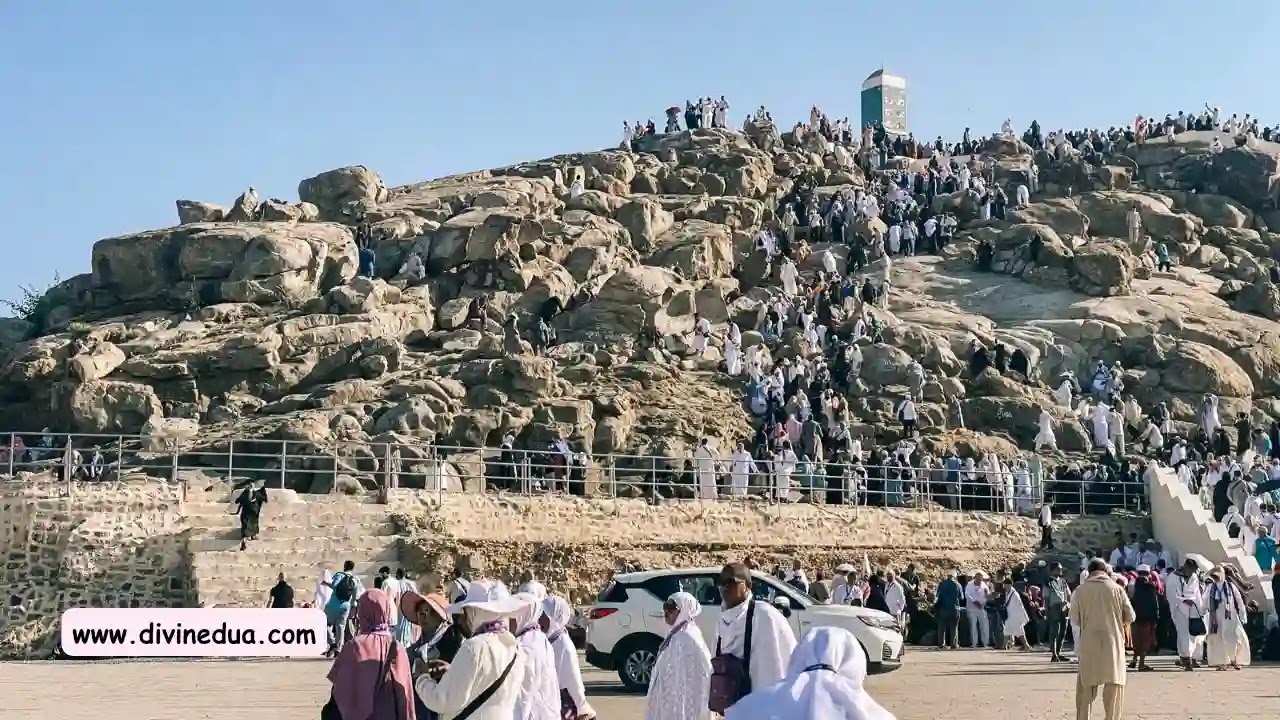
On the Day of Tarwiyah, the 8th day of Dhul Hijjah, you will head to the vast tent city of Mina after sunrise. You will spend the day and the entire night here in worship, prayer, and spiritual preparation for the most important day of Hajj that follows.
There are no specific, unique rituals for this day. The primary actions are to settle into your assigned Mina tents and perform your five daily prayers at their prescribed times, shortened (Qasr) but not combined. Dhuhr, Asr, and Isha are prayed as two rak’ahs each, while Fajr and Maghrib are prayed in full. This day is a gift from Allah—a day of rest, reflection, and anticipation for the journey to Arafat.
Practical Tip: The tents in Mina can be crowded. Pack a very small bag with only your essentials for the next few days. Use this time to connect with fellow pilgrims, read the Quran, and mentally prepare your heart for the standing at Arafat.
A Pilgrim’s Diary Entry:
“Arriving in Mina felt like entering another world. A city of white tents stretching as far as the eye can see, filled with hearts all beating for the same purpose. The air is filled with the sound of the Talbiyah. There’s a profound sense of calm and brotherhood here. We are all the same, dressed in the same simple cloth, waiting for the great day. This is the calm before the most beautiful spiritual storm.”
Step 4: The Day of Arafat (9th Dhul Hijjah) – The Heart of Hajj
The Prophet Muhammad (ﷺ) said, “Hajj is Arafat.” This is the single most important day of the entire pilgrimage, the absolute pinnacle of the journey. After the Fajr prayer in Mina, you will travel to the plains of Arafat.
The core ritual of the Day of Arafat is the Wuquf, which means “the standing.” From noon (after the Dhuhr prayer) until sunset, you will stand (or sit, if unable) in sincere and desperate supplication. This act is called the Wuquf at Arafat. This is the time your sins are forgiven, your duas are answered, and your soul is completely cleansed.
There is no specific set of supplications you must recite. This is your personal, one-on-one conversation with Allah. Pour out your heart, confess every sin, cry, and pray for everything you desire for this life and the next. The best Dua for Arafat and the best thing to say on this day is the declaration of Tawhid:
لَا إِلَهَ إِلَّا اللَّهُ وَحْدَهُ لَا شَرِيكَ لَهُ، لَهُ الْمُلْكُ وَلَهُ الْحَمْدُ وَهُوَ عَلَى كُلِّ شَيْءٍ قَدِيرٌ
Transliteration: “La ilaha illallahu wahdahu la sharika lah, lahul-mulku wa lahul-hamdu wa huwa ‘ala kulli shay’in qadir.”
Translation: “There is no god but Allah alone, with no partner or associate; His is the dominion, all praise is due to Him, and He is able to do all things.”
(Source: Jami` at-Tirmidhi)
A Pilgrim’s Diary Entry:
“Today, I stood on Arafat. The sun was intense, the heat was immense, but for the first time in my life, I felt none of it. I felt like a soul standing before its Creator, stripped of everything but its sins and its hopes. I raised my hands and the words just flowed, tears streaming down my face. I cried not from sadness, but from a profound sense of mercy washing over me. On this day, I understood what it truly means to be a servant of Allah. I felt my heart being washed clean, reborn.”
Step 5: The Night in Muzdalifah
Immediately after sunset on the Day of Arafat, your journey continues to Muzdalifah, an open plain located between Arafat and Mina. The experience here is one of profound humility and simplicity.
Upon arrival, you will perform your Maghrib (3 rak’ahs) and Isha (2 rak’ahs) prayers combined and shortened. After this, the main action of the Muzdalifah night is to rest and prepare for the busy day ahead. It is here that you will also be collecting pebbles for the stoning ritual (Rami). It is recommended to collect around 70 small, chickpea-sized pebbles to be used over the next three days.
There are no specific duas to be recited for collecting the pebbles, but you should remain in a state of remembrance. This night is a test of patience and reliance on Allah, spent under the open sky.
Practical Tip: The night in Muzdalifah is spent sleeping on the ground with minimal amenities. Travel light, embrace the humility of the experience, and get as much rest as you can. Collecting pebbles is not a race; they are everywhere. Find a quiet spot, rest, and reflect on the incredible day that has just passed.
A Pilgrim’s Diary Entry:
“After the intense emotions of Arafat, the night in Muzdalifah was a lesson in pure simplicity. Sleeping under the stars, on the same ground as millions of other pilgrims, I felt a profound sense of equality. As I collected each small pebble, I reflected on the sins and weaknesses I wanted to cast away. It wasn’t just a collection of stones; it was a gathering of intentions, preparing for the symbolic battle against my own ego.”
Step 6: Rami, Sacrifice & Tahallul (10th Dhul Hijjah)
The 10th of Dhul Hijjah, also known as Yawm al-Nahr (the Day of Sacrifice) or Eid al-Adha, is the busiest and most action-packed day of Hajj. You will perform three major rituals on this day, symbolizing your rejection of Shaytan, your gratitude to Allah, and your exit from the major restrictions of Ihram.
- Stoning the Devil (Rami): After returning to Mina from Muzdalifah, your first act is the Stoning the Devil (Rami). On this day, you will stone only the largest of the three pillars, known as Jamarat al-Aqabah. You will throw seven pebbles, one by one, saying “Allahu Akbar” (اللهُ أَكْبَرُ) with each throw.
- Sacrifice (Qurbani): Following the stoning, the sacrifice of an animal (Qurbani), such as a sheep or goat, is performed. This sacred act commemorates Prophet Ibrahim’s (AS) complete willingness to sacrifice his son for the sake of Allah. In modern Hajj, this is usually done by purchasing a voucher that delegates the sacrifice to be performed on your behalf.
- Shaving or Trimming (Tahallul): The final major rite of this day is Tahallul (shaving hair). After confirming your sacrifice has been made, men will either shave their heads completely (Halq), which is the superior option, or trim their hair (Taqsir). Women only trim a small lock of hair, about the length of a fingertip. This act is known as the first Tahallul. Upon completing it, it is recommended to face the Qibla and make this dua of gratitude:
الْحَمْدُ لِلَّهِ الَّذِي قَضَى عَنَّا نُسُكَنَا، اللَّهُمَّ زِدْنَا إِيمَانًا وَيَقِينًا وَعَوْنًا
Transliteration: “Alhamdullilahi-lladhi qada ‘anna nusukana. Allahumma zidna imanan wa yaqinan wa ‘awna.”
Translation: “All praise is for Allah who helped us complete our rites. O Allah, increase us in faith, certainty, and assistance.”
Once you complete this step, you are released from most of the restrictions of Ihram, with the exception of marital relations.
Practical Tip: This is a physically demanding day. The rituals can be performed in any order, although the recommended order is Rami, then Sacrifice, then Tahallul. Be patient with the crowds, stay hydrated, and perform the rituals at a pace that is comfortable for you.
A Pilgrim’s Diary Entry:
“Throwing those seven small pebbles felt like casting away all my past weaknesses and temptations. Each ‘Allahu Akbar’ was a declaration of God’s greatness over my own ego. Then came the trimming of the hair—a feeling of lightness, a physical manifestation of a spiritual rebirth. I felt like a newborn, with a clean slate from Allah and a heart overflowing with hope.”
Step 7: Tawaf al-Ifadah & Completing the Major Rites
After completing the rites of the 10th of Dhul Hijjah, you will travel back to Mecca to perform the Tawaf al-Ifadah. This is also known as Tawaf al-Ziyarah (the Tawaf of Visiting), and it is an essential pillar (rukn) of Hajj. Your Hajj is not complete without it.
This Tawaf consists of seven circuits around the Kaaba, followed by two rak’ahs of prayer behind Maqam Ibrahim, and then the Sa’i between Safa and Marwah if you did not perform it upon your arrival in Mecca. The supplications said during this Tawaf are the same as the Tawaf of Arrival, with a special focus on reciting “Rabbana atina…” between the Yemeni Corner and the Black Stone.
Once you complete this Tawaf, you achieve the second and final Tahallul. This means you are released from all restrictions of Ihram, including marital relations, and you can return to your regular clothes.
Practical Tip: The Mataf (the area around the Kaaba) can be extremely crowded on the 10th. Tawaf al-Ifadah can be performed anytime from the 10th up to the sunset of the 12th of Dhul Hijjah (though some scholars permit it later). Consider performing it on the 11th or 12th for a potentially calmer experience.
A Pilgrim’s Diary Entry:
“Returning to the Kaaba after the intensity of Arafat and Mina was like a homecoming. The first Tawaf was one of arrival, but this one was a Tawaf of gratitude. Circling the House of Allah, now free from most Ihram restrictions, I felt a sense of completion and overwhelming thankfulness. It felt like Allah was allowing me to visit His House as a purified guest, cleansed by the journey.”
Step 8: The Days of Tashreeq in Mina (11th-13th Dhul Hijjah)
After performing Tawaf al-Ifadah, you will return to your tent in Mina to spend the next two or three days. These are known as the Days of Tashreeq, which are days of eating, drinking, and remembering Allah, as mentioned by the Prophet (ﷺ).
The main ritual during the Rami Days 11-13 is to perform the stoning of the three pillars after noon each day. You will stone them in the following order:
- Jamarat al-Ula (the small pillar): Throw seven pebbles, saying “Allahu Akbar” with each. After stoning, it is a Sunnah to step aside, face the Qibla, and make a long, heartfelt dua.
- Jamarat al-Wusta (the middle pillar): Throw seven pebbles, saying “Allahu Akbar” with each. Again, it is a Sunnah to step aside, face the Qibla, and make a lengthy dua.
- Jamarat al-Aqabah (the large pillar): Throw seven pebbles, saying “Allahu Akbar” with each. After stoning this pillar, you do not stop to make dua; you simply leave.
You will repeat this process on the 12th of Dhul Hijjah. You then have the option to either leave Mina before sunset or stay for the 13th and perform the Rami one final time.
Practical Tip: The stoning area can be very crowded, especially in the early afternoon. Consider going later in the day when the crowds are smaller. If you are performing Hajj with the elderly or weak, you can delegate the stoning to a member of your group.
A Pilgrim’s Diary Entry:
“The days in Mina were a lesson in patience and community. We were all equal in our simple tents, sharing food, stories, and prayers. The daily walk to perform Rami was a powerful reminder that the struggle against temptation is not a one-time event, but a daily, consistent effort. These days were calm, reflective, and deeply bonding.”
Step 9: The Farewell Tawaf (Tawaf al-Wada’)
Before you finally leave the blessed city of Mecca, you must perform one last, poignant ritual: the Farewell Tawaf. The Tawaf al-Wada’ is a mandatory (wajib) act for all pilgrims who are not residents of Mecca. It is your final circumambulation of the Kaaba, a final goodbye to the House of Allah.
There are no specific new supplications for this Tawaf. You should perform the seven circuits as you did before, making heartfelt personal duas, glorifying Allah, and reciting “Rabbana atina…” between the Yemeni Corner and the Black Stone. The essence of this Tawaf is not in new words, but in the overwhelming feeling of gratitude for the journey He allowed you to complete, and a deep-seated longing to return.
After completing the Tawaf and its two rak’ahs of prayer, it is recommended to drink Zamzam water one last time. Following this, you should leave the Masjid al-Haram without unnecessarily lingering, as this act symbolizes your departure.
Practical Tip: It is a beautiful tradition to walk away from the Kaaba backwards after your Farewell Tawaf, so as not to turn your back on the House of Allah until it is out of sight. This is not a required act, but a gesture of deep love and reverence.
A Pilgrim’s Diary Entry:
“This was the hardest goodbye of my life. With every circle of the Farewell Tawaf, my heart grew heavier. I tried to burn the image of the Kaaba into my memory, to capture every detail. As I walked away backwards, watching the magnificent structure grow smaller, I couldn’t hold back my tears. They were not tears of sadness, but tears of hope—hope that Allah accepted my Hajj, and hope that He would honor me with an invitation to be His guest once again.”
Your FREE Hajj Toolkit (Printable PDF & More)
To help you navigate the blessed days of Hajj with ease and focus, we have created a comprehensive toolkit. This includes a visual map of the Hajj journey and a detailed checklist you can print and take with you.
Map of the Hajj Days (Infographic)
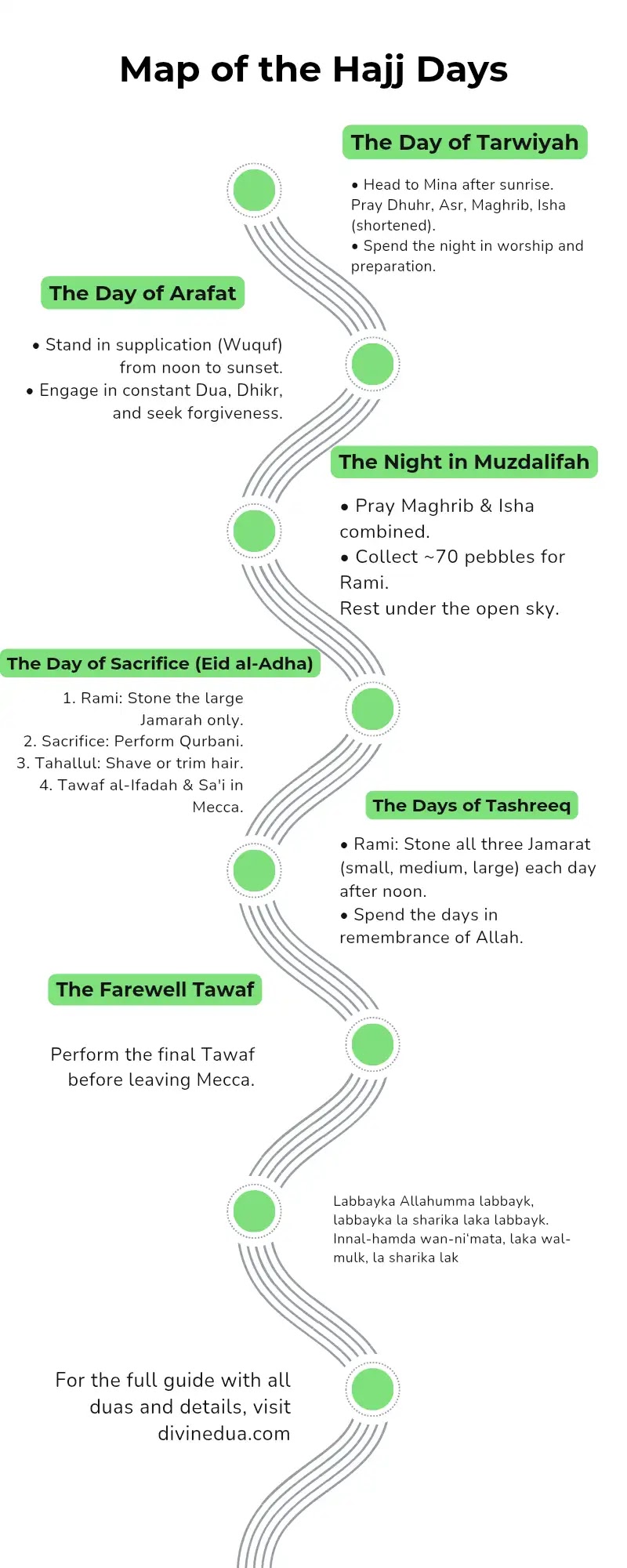
Here is a visual summary of the key rituals on each day to help you remember the sequence of events. Save this image to your phone or print it as a quick reference guide.
The Ultimate Hajj Checklist PDF
To ensure you have everything you need in one place, we have designed a comprehensive Hajj checklist. This printable PDF includes the packing list, essential duas, and a simplified schedule of the daily rituals. Download it, print it, and let it be your trusted companion.
Life After Hajj: How to Protect Your Clean Slate
Returning from Hajj is like being given a fresh start, a clean slate, and a heart full of light. The biggest challenge now is to maintain that spiritual high and protect the blessings you have earned. The real journey of your life after Hajj begins after the pilgrimage ends.
After completing the rites of Hajj, many pilgrims continue their spiritual journey by traveling to Madinah to visit the Prophet’s Mosque (Masjid an-Nabawi), a visit that completes the heart’s pilgrimage.
Signs of an Accepted Hajj (Hajj Mabrur)
While only Allah knows for sure, scholars mention that one of the greatest signs of an accepted Hajj is that you return as a better person than you were before you left. This includes:
- Your heart is softer and you have a stronger desire to perform good deeds.
- You find it easier to stay away from the sins you used to commit.
- You treat your family, friends, and community with more kindness and patience.
- Your love for Allah and His Messenger (ﷺ) has visibly increased, and you are more consistent in your prayers.
Practical Tips to Maintain Your Hajj Spirit
- Set Small, Consistent Goals: Don’t try to change everything overnight. Start with small, consistent acts of worship, like praying your sunnah prayers, reading a page of the Quran daily, or maintaining your morning and evening adhkar.
- Find Righteous Company: Surround yourself with friends who will remind you of Allah and encourage you on your journey of faith. The environment you place yourself in after Hajj is crucial.
- Relive the Memories: Look at your photos from Hajj, recall the feelings you had at Arafat and in front of the Kaaba, and use those memories to refuel your Iman when it feels low.
- Share Your Experience: Sharing your story (without boasting) can be a powerful reminder for yourself and an inspiration for others to perform Hajj. This act of sharing can reinforce the lessons you learned.
Frequently Asked Questions about Hajj
Q1: What is the difference between Hajj and Umrah?
Hajj is the major pilgrimage, one of the five pillars of Islam, and is obligatory for those who are able. It can only be performed during a specific time of the year (the month of Dhul Hijjah). Umrah is the minor pilgrimage, it is not obligatory, and can be performed at any time of the year. The rituals of Hajj are far more extensive and take several days, while Umrah can be completed in a few hours.
Q2: What is the meaning of Ihram?
Ihram is a sacred state of spiritual purity that a pilgrim enters. It is symbolized by the simple white garments worn by men and the intention in the heart. While in Ihram, certain worldly actions become forbidden, such as using perfume, cutting hair or nails, and arguing. This state is designed to create a sense of equality, humility, and complete focus on worship.
Q3: What happens if I miss a ritual or make a mistake?
Islamic jurisprudence (fiqh) is merciful and has solutions for mistakes. If you miss a pillar (rukn) of Hajj, like the standing at Arafat, your Hajj is invalid and must be repeated. However, if you miss a mandatory act (wajib), like the Farewell Tawaf, it can usually be compensated for by offering a sacrifice (known as ‘damm’). For minor mistakes, sincere repentance is often sufficient. It is always best to consult with a scholar.
Q4: What are the three types of Hajj?
There are three ways to perform Hajj:
1. Hajj al-Ifrad: The pilgrim enters Ihram with the intention of performing Hajj only.
2. Hajj al-Qiran: The pilgrim enters Ihram with the intention of performing both Hajj and Umrah together with the same Ihram.
3. Hajj al-Tamattu’: This is the most common and recommended type. The pilgrim performs Umrah first, exits the state of Ihram, and then re-enters Ihram for Hajj on the 8th of Dhul Hijjah.
Conclusion: The End of One Journey, The Beginning of Another
Completing the Hajj is a monumental achievement, a spiritual peak that pilgrims carry in their hearts for a lifetime. This step-by-step guide was designed to be your practical and spiritual companion, to help you navigate the rituals so you can focus on what truly matters: your personal connection with Allah.
Remember, the goal of Hajj is to return as you were on the day your mother gave birth to you—pure and free of sin. The true sign of an accepted Hajj is the positive change it brings to your character, your worship, and your outlook on life.
We pray that Allah accepts your Hajj, forgives your sins, and allows this journey to be the beginning of a new, more beautiful chapter in your life. Ameen.