
Every believer carries a “wishlist” in their heart—silent whispers for a breakthrough, a healing touch, or a new beginning. But have you ever wondered about the best way to ask Allah for something so that your prayer truly reflects your heart’s depth?
Most people assume that how to ask Allah for something is merely about repeating certain phrases. However, the spiritual reality is much deeper. There is a profound distinction between a passive wish and a focused, heart-centered request made with the sacred etiquette that resonates through the heavens.
“And when My servants ask you, [O Muhammad], concerning Me – indeed I am near. I respond to the invocation of the supplicant when he calls upon Me…”
— Surah Al-Baqarah [2:186]
The best way to phrase your dua isn’t about using complex or poetic language; it’s about aligning your words with the raw sincerity of your soul. Whether you are asking Allah for specific things—like a career milestone, a righteous spouse, or a family blessing—the clarity and intentionality behind your phrasing can transform your entire spiritual experience.
Pro Tip: Before mastering the phrasing, it’s essential to understand the core etiquette. Check out our detailed guide on
How to Make Dua Properly to set the right foundation.
In this guide, we won’t just discuss the steps; we will also explore the art of phrasing your requests and the spiritual mindset that makes your call to Allah more powerful and effective.
What Is the Best Way to Ask Allah for Something?
The best way to ask Allah is to combine a humble heart with clear, specific phrasing. Begin by praising Allah and sending blessings upon the Prophet ﷺ. Then, present your request with full certainty (Yaqeen), choosing the most appropriate Names of Allah (Asma-ul-Husna) for your specific need, and always align your worldly desires with the goodness of the Hereafter.
In This Guide, You Will Learn:
Beyond Words: Asking with Certainty (Yaqeen)
Before you even utter a single word, the “success” of your request begins within. Asking Allah is not like placing an order at a store; it is a spiritual posture. To ask in the best way, you must first master the internal state of Yaqeen—absolute certainty that Allah hears you and is more than capable of answering.
The Power of Trust
Asking Allah is an act of Ibadah (worship) in itself. When you ask, you are testifying to His existence and His Infinite Power. This realization shifts your focus from “What will I get?” to “Who am I talking to?”.
Detachment from the Outcome
The highest form of asking is to call upon Allah with passion while your heart remains attached only to the Giver, not the gift. This is the essence of Tawakkul—knowing that His wisdom in giving or withholding is perfect.
Unsure if your heart is in the right place? You might find clarity in our diagnostic guide:
Why Some Duas Are Not Answered.
The Language of Sincerity: Using the Divine Keys
Imagine having a set of keys, each designed to open a specific door. The Names of Allah (Asma-ul-Husna) are those keys. When you choose a Name that matches your specific need, it transforms your request from a generic wish into a deeply personalized conversation.
Choosing the Right Names
When asking Allah for specific things, tailor your language to reflect His attributes:
-
💰 For Provision & Career: Use “Ya Razzaq” (The Provider) or “Ya Fattah” (The Opener).
Example: “O Razzaq, provide for me from sources I never expected.” -
🌿 For Healing & Relief: Use “Ya Shafi” (The Healer) or “Ya Latif” (The Most Subtle/Kind).
Example: “O Shafi, grant me a cure that leaves no trace of illness.”
Why This Matters
Phrasing your request using His specific attributes shows a deeper understanding of what you are asking. It demonstrates that you have studied your Creator and recognize His unique role in fulfilling your specific desire. This level of Ma’ rifah (knowledge) is a powerful catalyst for acceptance.
For a complete list of the 99 Names and their meanings to enhance your phrasing, refer to
this authentic narration in Sunnah.com.
The Art of Phrasing: Moving from Vague to Vivid
Allah knows what is in your heart before you even speak, so why does the way we phrase our requests matter? Because clarity in your words reflects clarity in your soul. When you are asking Allah for specific things, you aren’t informing Him of something He doesn’t know; you are demonstrating your own focus, need, and Ikhlas (sincerity).
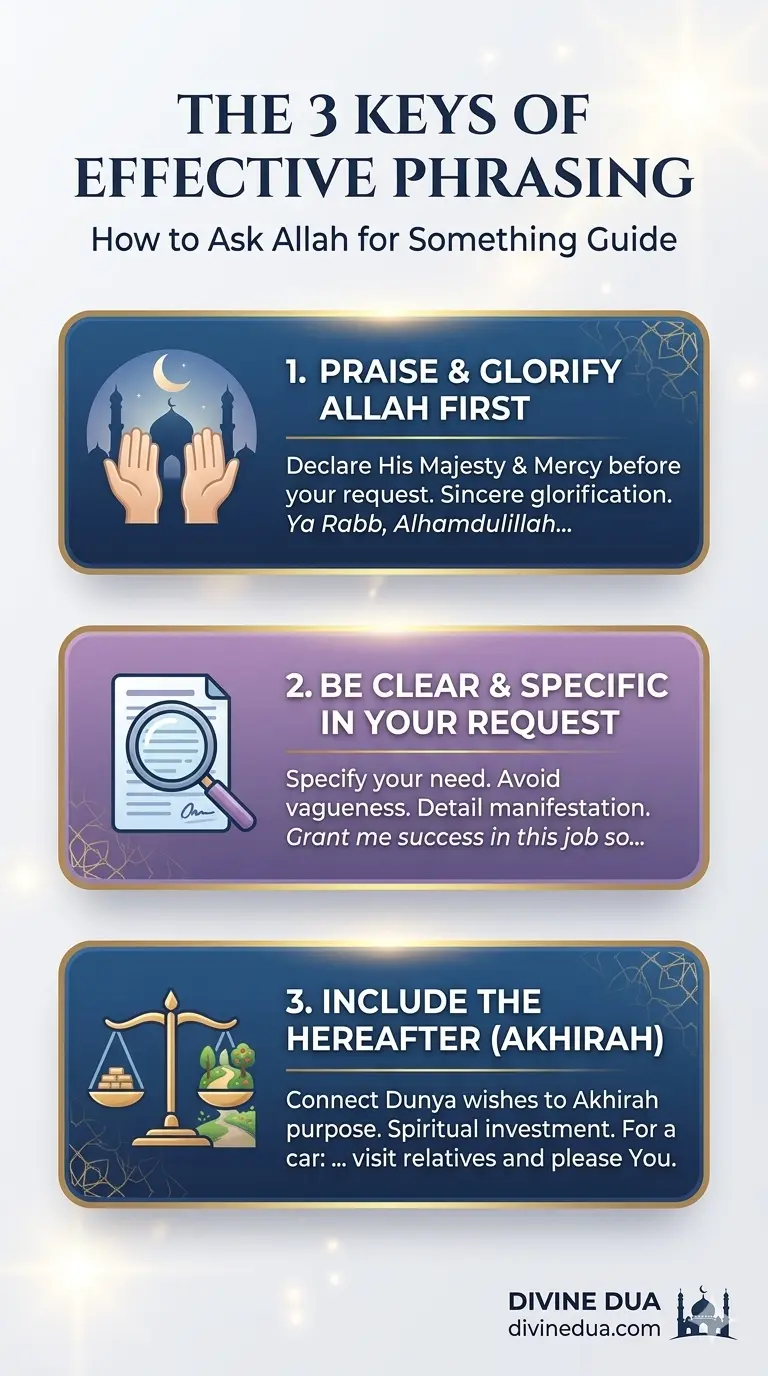
1. Don’t Just Ask, Specify
Vague prayers often lead to vague awareness of Allah’s response. To ask in the best way, break down your “big” needs into clear, meaningful requests.
The Power of Specificity
“O Allah, grant me success.”
“O Allah, grant me success in this specific project, make it easy for me, and let it be a source of Barakah for my life.”
2. The “Why” Behind the “What”
One of the most powerful ways to strengthen your dua is to explain the intention behind your request. When you tell Allah why you want something, you are aligning your worldly desire with a spiritual purpose.
“Instead of just asking for a higher salary, try saying: ‘O Allah, grant me this job so that I can support my family with halal earnings, provide for my parents, and spend in Sadaqah for Your sake.'”
This method is rooted in the Sunnah. Even the Prophets asked for things by explaining their purpose—not because Allah needed to know, but to manifest their Ubudiyyah (servitude). For instance, the Prophet ﷺ often asked for guidance not just for its own sake, but to remain steadfast on the straight path.
💡 A Moment for Reflection:
If you feel your phrasing is now clear and specific, yet you still face delays in your response, it might be time to look deeper. Explore the hidden spiritual barriers in our guide on
Best Time to Make Dua in Islam.
The Divine Balance: Linking Dunya to Akhirah
Islam does not ask you to abandon your worldly desires; it asks you to sanctify them. The most successful way to ask Allah for something is to ensure your request isn’t a “dead end” that stops at this life, but a bridge that leads to the next.
The Prophetic Formula: The Ultimate Shortcut
The Prophet ﷺ taught us the most comprehensive phrasing in the history of supplication. It is a formula that covers every possible need without leaving anything out:
“رَبَّنَا آتِنَا فِي الدُّنْيَا حَسَنَةً وَفِي الْآخِرَةِ حَسَنَةً وَقِنَا عَذَابَ النَّارِ”
“Our Lord, give us in this world [that which is] good and in the Hereafter [that which is] good and protect us from the punishment of the Fire.”
— [Quran 2:201]
Turning Worldly Requests into Spiritual Investments
When you are asking Allah for specific things—like a new car, a house, or a promotion—the “art” lies in the intention. You can turn a purely material request into an act of worship by changing your “Why”:
- 🏠 The House: “O Allah, grant me a spacious home so I can host my family, honor my guests, and create an environment where Your name is remembered.”
- 🚗 The Car: “O Allah, grant me a reliable vehicle so I can fulfill my duties, visit my relatives (Sila-e-Rahmi), and use it for things that please You.”
To make it even easier for you, here is a visual summary of the best way to ask Allah for something using the three essential keys we’ve discussed so far:
Practical Examples: Ready-to-Use Phrasing Templates
To help you apply these concepts, here are a few “Dua Templates” that combine the best way to phrase your dua with the Names of Allah and the principle of spiritual investment.
Remember: Even with the perfect phrasing, the heart’s condition is paramount. If you’re wondering about the foundational adab, don’t miss our guide on
How to Make Dua Properly.
FAQs: Common Questions on the Art of Asking
As you refine your approach to how to ask Allah for something, a few common questions often arise. Here are the answers to help you pray with total clarity.
Q: Can I ask Allah for very small, everyday things?
Answer: Absolutely. In fact, the Prophet ﷺ encouraged us to ask Allah for everything, even a shoelace or salt for our food. There is nothing “too small” for the One who created the vast universe. Asking for small things isn’t about the item itself; it’s a beautiful declaration of your complete dependence on Him for every second of your existence.
Q: Should I use Arabic or is my own language enough?
Answer: While the Arabic language is blessed and chosen for the Quran, Allah created all languages and knows what is hidden in every heart. If you don’t know Arabic, ask Him in the language that moves your soul. Sincerity (Ikhlas) is the most important “language” in dua. Speak to Him with the words that come naturally to you; He hears the whisper of the heart before the movement of the tongue.
Ready to Master the Full Etiquette?
Now that you’ve learned the best way to phrase your dua, ensure you are following the complete Sunnah-based protocol.
Final Thoughts: The Conversation Never Ends
Asking Allah is more than a means to an end; it is a lifelong conversation with the One who loves you more than a mother loves her child. By mastering the art of asking—being specific, using His Names, and linking your Dunya to your Akhirah—you transform your dua from a simple request into a powerful spiritual bond.
Start today. Use the templates, align your heart, and trust that He will respond in the way that is most perfect for you.