

My dear brother and sister, have you ever raised your hands in the darkness of the night, your heart heavy with a need only Allah knows, and wondered: “Is He listening? Why do I feel like my prayers aren’t being answered?”
It is a common struggle for many of us. We make dua, but we often feel disconnected because we don’t know the best time to make dua or we lack the certainty that our whispers are reaching the heavens. This feeling of “silence” can lead to doubt, making us wonder exactly when dua is accepted and if we are missing those sacred windows of mercy.
If you have ever felt like your prayers are hitting a wall, or you simply want to ensure you are calling upon your Creator at the most beloved moments, you are not alone. Understanding the best times for dua is not just about “timing”—it’s about positioning your soul at the gates of Allah’s Rahmah when they are wide open.
Sometimes, the feeling of rejection comes from a place of deep worry. If you are currently going through a hard time, I encourage you to also read our guide on Dua for Anxiety to find immediate peace for your heart.
In this complete guide, you will discover the best times to make dua in Islam, supported by authentic evidence from the Quran and Sunnah.
There are moments when the distance between your heart and Allah’s mercy is just a sincere dua.
What Is the Best Time to Make Dua in Islam?
The best time to make dua in Islam includes the last third of the night, the period between the adhan and iqamah, during sujood (prostration), on Fridays, and while fasting. These are the specific moments when dua is more likely to be accepted according to the authentic teachings of the Quran and Sunnah.
My dear brother and sister, understanding these specific windows of opportunity is like knowing when the doors of a King are wide open for his subjects. While Allah (SWT) hears us at all times, He has blessed us with these “golden hours” to help us draw even closer to Him.
Quick Summary: Best Times for Dua
If you are looking for a fast answer, here are the most blessed moments to reach out to Allah (SWT):
- The last third of the night (Tahajjud time).
- Between the Adhan and the Iqamah.
- During Sujood (Prostration in prayer).
- On Fridays (Especially the last hour before Maghrib).
- While fasting and at the moment of Iftar.
In This Guide, You Will Learn:
- Why timing matters in your relationship with Allah.
- The primary best times when dua is accepted.
- Authentic evidence from the Quran and Sunnah.
- Hidden powerful moments for dua that many Muslims forget.
- Common mistakes that might hinder your dua’s acceptance.
- FAQs about dua timing and consistency.
Does Timing Really Matter for Dua in Islam?
My dear brother and sister, you might be thinking: “If Allah (SWT) is the All-Hearing (Al-Sami’) and the All-Knowing (Al-Alim), and He is closer to me than my jugular vein, does it really matter when I call upon Him?”
The short and powerful answer is: Yes, timing has a significant impact on the acceptance of your dua. While it is true that Allah’s mercy is limitless and His doors are never closed, He—in His infinite wisdom—has designated specific moments where the “gates of heaven” are opened even wider. These are times of special divine favor and Rahmah (mercy).
Think of it as a special invitation. While a King may hear his subjects at any time, he often sets aside specific hours to grant audiences and fulfill requests. In Islam, Allah (SWT) encourages us to seek Him at all times, but He highlights these special windows to increase our hope and focus.
Allah (SWT) says in the Holy Quran:
“Call upon Me; I will respond to you.”
— [Surah Ghafir 40:60]
By learning these special moments, you are showing Allah your eagerness and your dedication to seeking His pleasure when He has promised to be most responsive. It is a way of showing Adab (etiquette) with your Creator.
However, my brother/sister, remember that while timing is a “key” to the door of acceptance, how you turn that key is just as important. If you want to make sure your heart and manners are ready, don’t forget to check our guide on How to Make Dua Properly.
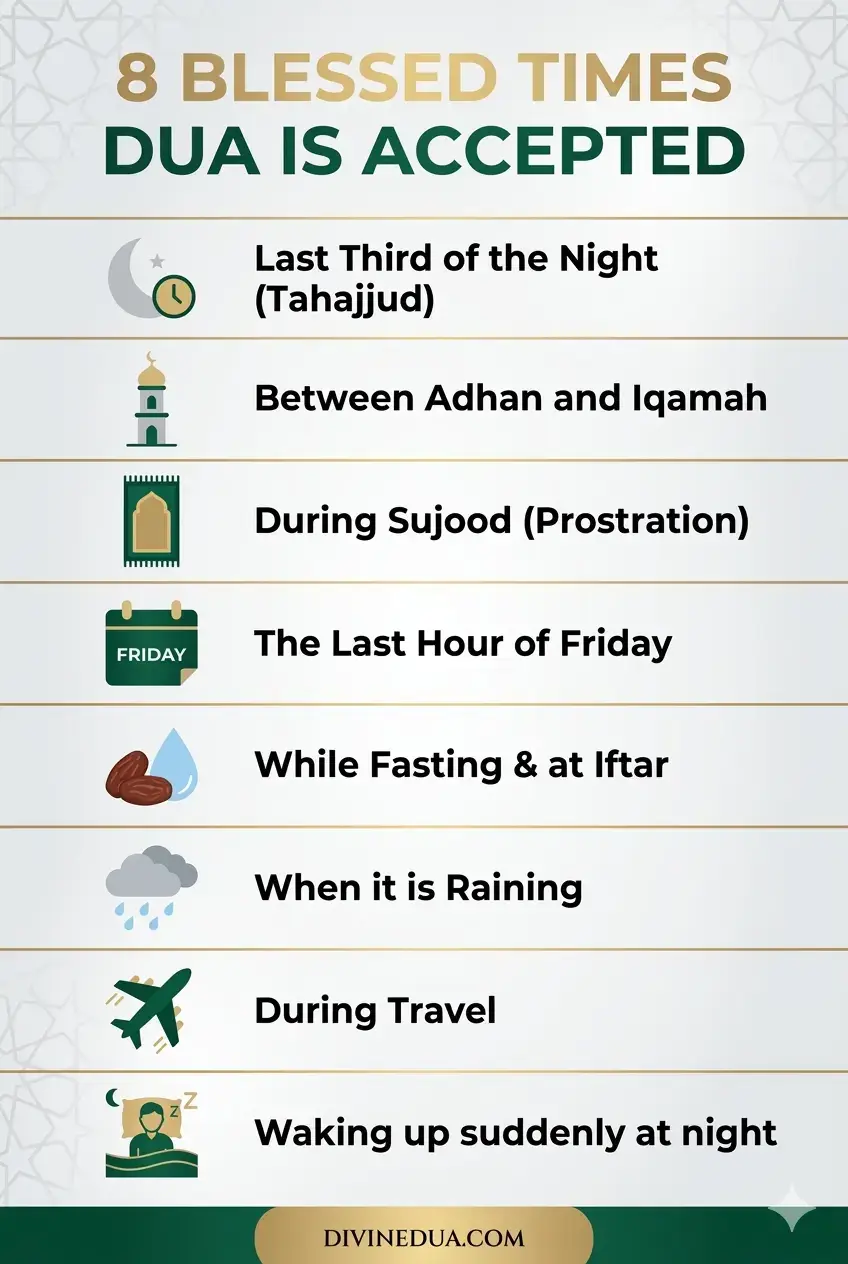
Best Times When Dua Is Accepted in Islam
My dear brother and sister, now that we understand why timing is a gift from Allah, let’s explore the specific moments where the Prophet Muhammad (PBUH) taught us that our chances of acceptance are at their highest.
1. The Last Third of the Night
This is arguably the most powerful and best time to make dua. While the rest of the world is wrapped in sleep, you are awake for the One who never sleeps.
The Evidence: The Prophet (PBUH) said: “Our Lord descends every night to the lowest heaven when one-third of the night remains and says: ‘Who will call upon Me, that I may answer Him? Who will ask of Me, that I may give him? Who will seek My forgiveness, that I may forgive him?’”
— [Sahih al-Bukhari]
Why it matters: This is a time of pure Ikhlas (sincerity) and Khalwah (seclusion with Allah). It is the perfect time for Tahajjud. If you need help starting this habit, please see our Tahajjud Prayer Guide.
People Also Ask: What time is the last third of the night?
To calculate this, find the total time between Maghrib (sunset) and Fajr (dawn). Divide that total time by 3. The final third of that duration before Fajr starts is the last third of the night.
2. Between the Adhan and the Iqamah
The few minutes between the call to prayer (Adhan) and the start of the prayer (Iqamah) are often overlooked. My dear brother/sister, don’t let this time slip away by checking your notifications.
The Evidence: The Messenger of Allah (PBUH) said: “The supplication (dua) made between the Adhan and the Iqamah is not rejected.”
— [Sunan al-Tirmidhi]
3. During Sujood (Prostration)
There is no moment in your life where you are closer to your Creator than when your forehead is on the ground in total submission.
The Evidence: The Prophet (PBUH) said: “The nearest a slave comes to his Lord is when he is prostrating, so make much supplication (in this state).”
— [Sahih Muslim]
Question: Can you make dua in sujood in your own words?
Yes, you absolutely can! Pour your heart out in your own language with humility and focus (Khushu), as Allah understands every language and knows the depths of your heart.
4. On Fridays (Especially the Last Hour)
Friday is the “Eid of the week,” and Allah has hidden a specific hour within it where no Muslim asks for something except that Allah grants it.
The Evidence: The Prophet (PBUH) mentioned Friday and said: “There is a time on Friday… if a Muslim stands and prays and asks Allah for something at that time, Allah will give it to him.”
— [Sahih al-Bukhari]
Scholars generally agree that this “hour of response” is the last hour on Friday before Maghrib.
5. While Fasting and at the Moment of Iftar
When you restrain your body for the sake of Allah, your soul becomes elevated. This makes the time when dua is accepted very likely throughout your fasting day, and especially at the moment you break it.
The Evidence: “The dua of the fasting person will not be refused.”
— [Sunan al-Tirmidhi]
6. When It Is Raining
Rain is a physical manifestation of Allah’s Rahmah (mercy) on the earth. In many Hadiths, it is mentioned as a time of blessing where supplications are answered. Next time it rains, don’t just run for cover—raise your hands!
7. During Travel
Traveling often involves hardship and a feeling of being a “stranger.” This vulnerability brings you closer to Allah. The Prophet (PBUH) confirmed that the dua of a traveler is answered without doubt.
8. When You Wake Up at Night (Suddenly)
If you happen to wake up in the middle of the night, don’t just turn over and go back to sleep. There is a specific dua of waking up (the Tehlil) that, if followed by a request, will be granted.
The Evidence: The Prophet (PBUH) said that whoever wakes up and says: “La ilaha illallah…” and then says: “O Allah, forgive me” or makes a dua, it will be responded to.
— [Sahih al-Bukhari]
Hidden Powerful Moments Many Muslims Forget
My dear brother and sister, while many people know about Friday or the last third of the night, there are “hidden gems”—specific moments that are often overlooked but carry immense weight in the sight of Allah (SWT). Including these in your daily routine can truly distinguish your spiritual life from others.
1. Immediately After Wudu (Ablution)
We often rush from the sink to the prayer mat, but there is a powerful window of acceptance right after you finish your Wudu. It’s a moment of physical and spiritual purity.
The Evidence: The Prophet (PBUH) taught us that for whoever perfects their Wudu and then says: “Ashhadu an la ilaha illallah…” the eight gates of Paradise are opened for them to enter from whichever they wish.
— [Sahih Muslim]
Imagine, if the gates of Paradise are open, how could your sincere dua be turned away?
2. After Completing the Fard Prayers
Don’t be in such a hurry to leave your prayer spot. The moments immediately following your obligatory prayers are sacred.
The Lesson: While we perform our Dhikr (SubhanAllah, Alhamdulillah, Allahu Akbar), this is also a prime time when dua is accepted. Scholars mention that the “end of the prescribed prayers” is a time of response. Stay a few minutes longer and speak to your Lord; He just invited you to stand before Him, and now He is ready to give.
3. During Moments of Extreme Hardship (The “Emergency” Call)
When you feel like the world is closing in on you and you have no one else to turn to, you are in a state of Idtirar (desperate need). Allah specifically mentions that He responds to the one in distress.
The Evidence: “Is He [not best] who responds to the desperate one when he calls upon Him and removes evil…”
— [Surah An-Naml 27:62]
If you are feeling overwhelmed right now, please don’t carry that weight alone. I highly recommend you look at our [Dua for Anxiety] to find specific words to ease your heart during these difficult times.
4. When You Have Been Oppressed (Az-Zulm)
This is a serious warning for the oppressor and a source of great hope for the one who has been wronged. If someone has treated you unjustly, your dua has a direct “fast-track” to the heavens.
The Evidence: The Prophet (PBUH) said: “Beware of the supplication of the oppressed, for there is no barrier between it and Allah.”
— [Sahih al-Bukhari]
My brother/sister, use this moment not just to ask for justice, but to ask Allah for what is best for your soul, for He is the ultimate Judge.
How to Use These Times Effectively
My dear brother and sister, knowing the best time to make dua is like having the key to a treasure chest. But as any wise person knows, a key only works if you know how to turn it. To truly benefit from these sacred moments, your heart must be in the right state.

Here are four essential heart-actions to ensure your dua is as powerful as possible during these times:
-
1. Ikhlas (Complete Sincerity):
Your dua should come from the depths of your soul, directed solely to Allah (SWT). When you call upon Him, forget the world and focus only on your Creator. -
2. Yaqeen (Certainty of Response):
Never make dua with a “let’s see if this works” attitude. You must pray with the absolute conviction that Allah is listening and will answer you in the way that is best for you. The Prophet (PBUH) said: “Call upon Allah while you are certain of an answer.”
— [Sunan al-Tirmidhi] -
3. Persistence (Ilhah):
Allah loves those who are persistent. Don’t just ask once and stop. Repeat your dua three times, and keep asking day after day. This shows your true dependency on Him. -
4. Avoid Haste (Sabr):
One of the biggest “dua-killers” is saying, “I prayed and prayed, but He didn’t answer.” Be patient. Allah’s timing is always more perfect than ours.
Take it to the next level: While these tips are vital, there is a specific etiquette (Adab) that can further boost your acceptance. To master the art of supplication, I highly recommend reading our deep dive on
How to Make Dua Properly.
Common Mistakes That Block Dua Acceptance
My dear brother and sister, sometimes we do everything right, yet we feel a barrier between our hearts and Allah’s response. While Allah is the Most Merciful, we must be careful not to fall into habits that unintentionally “block” the very blessings we are asking for. Let’s look at four common mistakes so we can avoid them together.
Mistake #1: Ignoring the Special “Golden Windows”
The biggest mistake is simply not showing up when the doors are open. If you only make dua when you are in a rush or only during your five daily prayers, you are missing out on the best times for dua like the last third of the night or the hour before Maghrib on Friday. Don’t let these moments pass you by while you are scrolling on your phone or sleeping.
Mistake #2: Making Dua Without Heartfelt Focus (Khushu)
Have you ever found yourself reciting a dua while your mind was thinking about work, dinner, or a conversation you had earlier? My brother/sister, Allah does not answer a heart that is heedless and distracted. When you talk to the Creator of the Universe, give Him your full attention. Let your heart feel every word you say.
The Evidence: The Prophet (PBUH) said: “Know that Allah does not answer a supplication from a heart that is distracted and heedless.” — [Sunan al-Tirmidhi]
Mistake #3: Being Impatient (Al-Istij’al)
This is a trap many of us fall into. We pray for something for a week or a month, and when we don’t see the result, we say, “I made dua, but it wasn’t answered,” and then we stop. This haste is actually what prevents the response! Remember, Allah answers in three ways: Yes, Yes but later, or No—He has something better for you in the Hereafter.
Mistake #4: Doubting That Allah Will Accept Your Dua
If you make dua while thinking, “I’m too much of a sinner for Allah to listen to me,” or “This is impossible,” you are limiting the power of the One who says “Be” and it is. Approach Allah with Yaqeen (absolute certainty). He loves to give, and nothing is too big for Him to handle.
Note for my brother/sister: If you feel your dua is blocked because of your sins or high levels of stress, remember that Allah is Al-Ghafur (The Most Forgiving). You can find specific words of relief in our guide on [Dua for Anxiety].
Common Questions About Dua Timing
My dear brother and sister, here are some of the most common questions Muslims ask when seeking to improve their connection with Allah (SWT) through supplication.
Can Dua Be Accepted at Any Time?
Yes, absolutely. Allah (SWT) is Al-Sami’ (The All-Hearing), and His doors of mercy are open 24/7. You do not need to wait for a specific hour to talk to your Creator. However, as we have discussed, there are “virtuous times” where the reward and the likelihood of a response are much higher. Think of it this way: Allah hears you every second, but He invites you specifically during these best times for dua to grant you even more.
Is Night Better Than Day for Dua?
Generally speaking, yes, the night holds a special status. This is primarily because the night—especially the last third—is a time of peace, silence, and deep focus (Khushu). When the world is quiet, your heart can speak more clearly. If you are struggling to find time during the day, I highly encourage you to wake up even 15 minutes before Fajr. You can learn more about making the most of this time in our [Internal Link: Tahajjud Prayer Guide].
How Many Times Should You Make Dua?
There is no limit to how many times you can ask Allah for the same thing. In fact, Allah loves Al-Mulihheen—those who are persistent in their prayers. My dear brother/sister, do not feel like you are “bothering” Allah. Unlike humans, the more you ask of Allah, the more He loves you. Keep knocking on the door until it opens; persistence is one of the greatest signs of your faith (Iman).
Frequently Asked Questions About the Best Time for Dua
My dear brother and sister, to make sure you have everything you need to start your journey of supplication today, here are some final thoughts on the most common questions.
What is the most powerful time to make dua?
While every moment is an opportunity, the last third of the night is widely considered the most powerful time. This is because Allah (SWT) descends to the lowest heaven specifically to answer those who call upon Him. If you want to experience this peace, I strongly encourage you to look at our Tahajjud Prayer Guide.
Is dua accepted after every prayer?
Yes, the time immediately following your obligatory (Fard) prayers is one of the times when dua is accepted. The Prophet (PBUH) was once asked which supplication is heard most, and he replied: “In the last third of the night, and at the end of the prescribed prayers.” — [Sunan al-Tirmidhi].
Can dua be rejected?
This is a fear many of us have, but remember: Allah never “ignores” a sincere dua. However, the answer might come in different forms. He may give you exactly what you asked for, He may remove a harm that was coming your way instead, or He may save the reward for you in the Hereafter. If you feel your prayers aren’t being answered right away, it might be a test of your patience. To learn more about how to refine your approach, check our guide on [Internal Link: How to Make Dua Properly].
Final Thoughts: Your Direct Line to the Creator
My dear brother and sister, as we close this guide, I want you to remember one beautiful truth: Allah (SWT) is always listening. Whether it is the middle of a busy workday or the quietest moment of the night, He is closer to you than your own heart. The door to His mercy never has a “closed” sign on it.
However, as we have explored together, utilizing the best times to make dua is a way to show your sincerity, effort, and love for your Lord. When you choose to wake up for Tahajjud or stay on your prayer mat after the Adhan, you are telling Allah: “O my Lord, I am here at the door You opened for me, hoping for Your Rahmah.” This extra effort is what increases the likelihood of a response and brings immense Barakah (blessing) into your life.
Start Your Journey Today
Don’t wait for a “perfect” day to start. Start making dua during these powerful times today and feel the difference in your heart. Whether it is a small wish or a mountain of worry, give it all to Allah. Strengthen your connection with Him, for He is the only One who can truly change your reality.
Continue Your Spiritual Growth:
- Learn the proper etiquette in our guide: How to Make Dua Properly.
- Find peace in times of hardship: Dua for Anxiety.
- Master the night prayer with our Tahajjud Prayer Guide.